
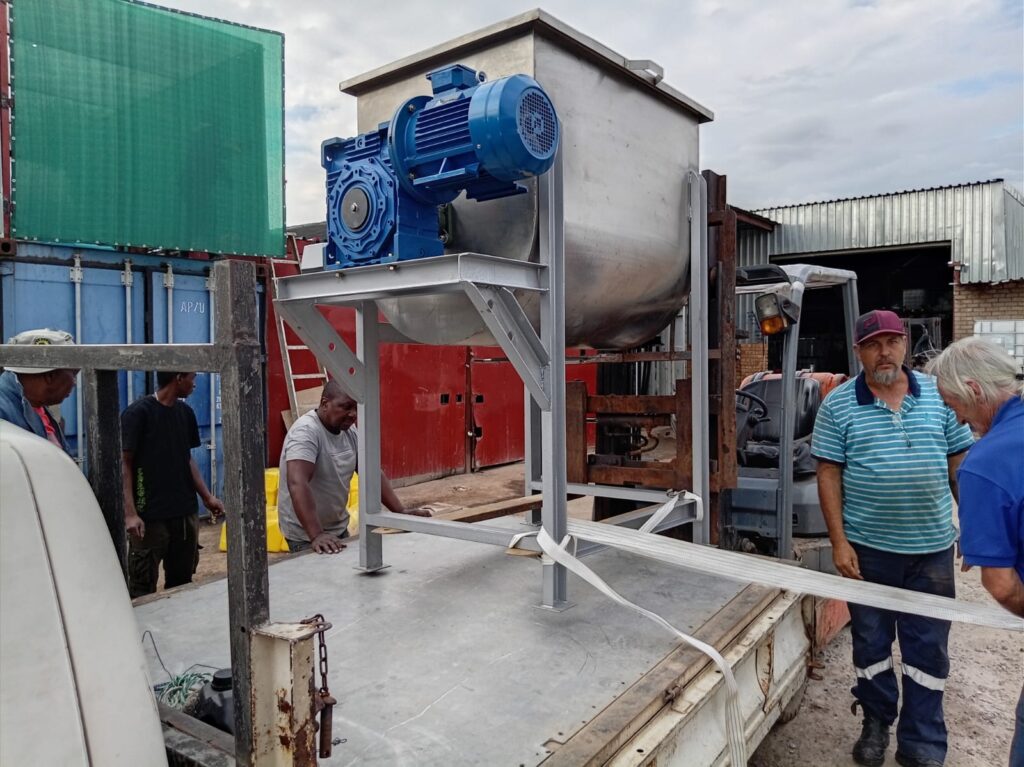
Ribbon blenders are manufactured in a wide range of capacities to suit small-scale production, medium-sized factories, and large industrial processing plants. Choosing the correct size is essential for achieving efficient mixing, reducing production time, and maximizing product consistency.
The size of a ribbon blender is typically determined by its process volume (working volume) rather than its total vessel volume.
Understanding Ribbon Blender Capacity
Process Volume
The actual volume of material that can be mixed effectively in one batch.
Gross Volume
The total internal volume of the mixing trough.
Most ribbon blenders operate most efficiently when filled to approximately 40%–70% of gross volume.
Standard Ribbon Blender Sizes
| Process Volume (L) | Gross Volume (L) | Batch Capacity (kg)* | Power (kW) |
|---|---|---|---|
| 50 | 75 | 20 – 35 | 1.5 |
| 100 | 150 | 40 – 60 | 2.2 |
| 200 | 300 | 80 – 120 | 4 |
| 300 | 450 | 120 – 180 | 5.5 |
| 500 | 750 | 200 – 300 | 7.5 |
| 1000 | 1500 | 400 – 600 | 11 |
| 1500 | 2250 | 600 – 900 | 15 |
| 2000 | 3000 | 800 – 1200 | 18.5 |
| 3000 | 4500 | 1200 – 1800 | 22 |
| 5000 | 7500 | 2000 – 3000 | 30 |
| 10000 | 15000 | 4000 – 6000 | 45 |
*Actual capacity varies according to product density.
Small Ribbon Blender Sizes (50L – 500L)
These machines are commonly used for:
- Product development
- Research laboratories
- Small food manufacturers
- Spice blending
- Nutritional supplements
- Specialty chemicals
Benefits
- Lower investment cost
- Easy cleaning
- Fast batch changes
- Compact footprint
Medium Ribbon Blender Sizes (1000L – 3000L)
Medium-capacity ribbon blenders are ideal for:
- Food processing plants
- Animal feed production
- Chemical manufacturing
- Cosmetic powder blending
Benefits
- Higher throughput
- Better production efficiency
- Suitable for continuous daily operation
Large Industrial Ribbon Blender Sizes (5000L – 10000L)
Large-scale ribbon blenders are designed for:
- Industrial chemical plants
- Fertilizer manufacturing
- Large feed mills
- Bulk food ingredient processing
Benefits
- High production output
- Reduced labor costs
- Lower cost per kilogram mixed
Typical Ribbon Blender Dimensions
Approximate dimensions vary by manufacturer.
| Process Volume (L) | Length (mm) | Width (mm) | Height (mm) |
|---|---|---|---|
| 100 | 1200 | 600 | 900 |
| 200 | 1500 | 700 | 1100 |
| 500 | 1800 | 900 | 1300 |
| 1000 | 2500 | 1200 | 1600 |
| 2000 | 3200 | 1400 | 1900 |
| 3000 | 3800 | 1600 | 2100 |
| 5000 | 4800 | 1800 | 2400 |
| 10000 | 6500 | 2200 | 3000 |
How to Choose the Right Ribbon Blender Size
Calculate Your Batch Requirement
Determine how many kilograms of product need to be mixed per batch.
Consider Product Density
Heavy materials require larger motors and may reduce effective capacity.
Evaluate Production Targets
Consider:
- Daily production volume
- Number of batches per day
- Future expansion plans
Allow Space for Growth
Many manufacturers choose a ribbon blender 20–30% larger than their current requirement to accommodate future production increases.
Industries and Recommended Ribbon Blender Sizes
| Industry | Recommended Size |
|---|---|
| Spice Processing | 100L – 1000L |
| Flour Mixing | 500L – 3000L |
| Animal Feed | 1000L – 10000L |
| Chemical Powders | 500L – 5000L |
| Pharmaceutical Powders | 50L – 1000L |
| Cosmetic Products | 100L – 1500L |
| Fertilizer Production | 2000L – 10000L |
Conclusion
Ribbon blenders are available in sizes ranging from compact 50-liter units to large 10,000-liter industrial systems. The correct size depends on your batch requirements, material density, available floor space, and production goals. By selecting the appropriate process volume and motor power, manufacturers can achieve efficient mixing, consistent product quality, and maximum productivity