
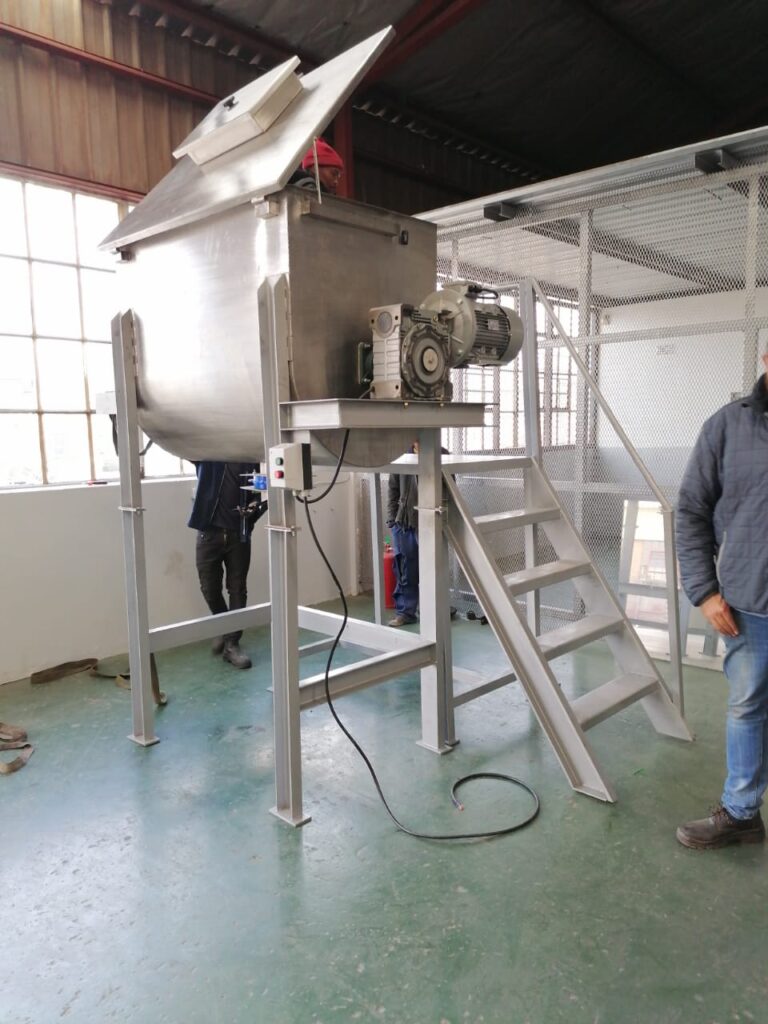
A ribbon blender is one of the most widely used industrial mixing machines for blending powders, granules, dry ingredients, and semi-wet materials. It is commonly found in food processing, pharmaceuticals, chemicals, cosmetics, agriculture, and manufacturing industries.
The machine consists of a U-shaped horizontal trough and a specially designed ribbon agitator that moves materials in opposite directions, creating a homogeneous mixture within a short period.
Due to its versatility, efficiency, and cost-effectiveness, ribbon blenders have become a preferred choice for manufacturers looking to achieve consistent product quality.
What is a Ribbon Blender?
A ribbon blender is a horizontal mixing machine equipped with inner and outer helical ribbons mounted on a central shaft.
As the shaft rotates:
- The outer ribbon moves materials from the ends toward the center.
- The inner ribbon moves materials from the center toward the ends.
This counter-current movement creates a balanced mixing action that ensures uniform blending of materials.
How Does a Ribbon Blender Work?
The mixing process involves three simultaneous movements:
1. Radial Movement
Materials move from the outer wall toward the center of the mixer.
2. Axial Movement
The ribbon agitator moves product lengthwise through the trough.
3. Convective Mixing
Particles continuously exchange positions, producing a highly uniform blend.
This combination allows ribbon blenders to achieve mixing uniformity levels exceeding 95%.
Main Components of a Ribbon Blender
Mixing Chamber
A U-shaped trough that holds the product during mixing.
Ribbon Agitator
Consists of inner and outer ribbons welded onto a central shaft.
Drive System
Includes the motor, gearbox, coupling, and bearings.
Discharge Valve
Allows quick unloading after mixing.
Safety Cover
Protects operators and prevents contamination.
Control Panel
Used to operate and monitor the mixing process.
Ribbon Blender Capacity and Technical Specifications
The table below provides typical specifications for industrial ribbon blenders.
| Process Volume (L) | Working Capacity (kg)* | Gross Volume (L) | Power (kW) |
|---|---|---|---|
| 100 | 40 – 60 | 150 | 2.2 |
| 200 | 80 – 120 | 300 | 4 |
| 300 | 120 – 180 | 450 | 5.5 |
| 500 | 200 – 300 | 750 | 7.5 |
| 1000 | 400 – 600 | 1500 | 11 |
| 1500 | 600 – 900 | 2250 | 15 |
| 2000 | 800 – 1200 | 3000 | 18.5 |
| 3000 | 1200 – 1800 | 4500 | 22 |
| 5000 | 2000 – 3000 | 7500 | 30 |
| 10000 | 4000 – 6000 | 15000 | 45 |
*Actual capacity depends on material density.
Industries That Use Ribbon Blenders
Food Industry
Ribbon blenders are used for:
- Spice mixing
- Seasoning production
- Flour blending
- Protein powder mixing
- Beverage powder production
- Baking ingredient preparation
Chemical Industry
Common applications include:
- Detergent powders
- Pigments
- Fertilizers
- Construction chemicals
- Plastic additives
Pharmaceutical Industry
Used for blending:
- Active ingredients
- Excipients
- Nutritional supplements
- Medical powders
Agriculture Industry
Applications include:
- Animal feed production
- Feed premixes
- Mineral supplements
- Seed treatment compounds
Advantages of Ribbon Blender Machines
Excellent Mixing Uniformity
Ribbon blenders provide highly consistent mixing results across large batches.
Fast Mixing Time
Most products can be blended within 5 to 15 minutes.
Large Production Capacity
Available in sizes ranging from laboratory units to industrial-scale systems exceeding 10,000 liters.
Low Operating Costs
Simple mechanical design reduces maintenance expenses.
Versatile Applications
Suitable for powders, granules, flakes, and certain paste-like materials.
Durable Construction
Typically manufactured from stainless steel 304 or 316 for long service life.
Ribbon Blender Materials of Construction
Stainless Steel 304
Ideal for food, cosmetic, and general industrial applications.
Stainless Steel 316
Recommended for pharmaceutical and corrosive products.
Carbon Steel
Used for non-corrosive industrial materials where budget is a priority.
Factors to Consider When Choosing a Ribbon Blender
Batch Size
Determine the amount of material processed per cycle.
Material Characteristics
Consider particle size, density, moisture content, and flowability.
Mixing Time
Choose a machine that meets production requirements.
Construction Material
Select food-grade or pharmaceutical-grade stainless steel when required.
Discharge System
Options include:
- Butterfly valve
- Slide gate valve
- Pneumatic discharge valve
Cleaning Requirements
For frequent product changes, a sanitary design may be necessary.
Common Optional Features
Modern ribbon blenders can be equipped with:
- Spray systems for liquid addition
- Heating jackets
- Cooling jackets
- Vacuum systems
- Load cells
- PLC controls
- Variable speed drives
- Dust collection systems
Maintenance Tips for Ribbon Blenders
To maximize equipment lifespan:
- Inspect bearings regularly.
- Lubricate moving parts according to manufacturer recommendations.
- Check ribbon alignment periodically.
- Clean the mixing chamber after every batch.
- Inspect seals and gaskets for wear.
- Monitor gearbox oil levels.
Proper maintenance can significantly reduce downtime and repair costs.
Why Ribbon Blenders Remain the Industry Standard
Ribbon blenders continue to dominate industrial mixing because they offer an excellent balance between efficiency, capacity, reliability, and affordability. Whether used for food products, chemicals, pharmaceuticals, or agricultural materials, they deliver fast and uniform mixing while maintaining low operating costs.
For manufacturers seeking a dependable powder mixing solution, a stainless steel ribbon blender remains one of the most effective and proven choices available today.
SEO FAQ
What is a ribbon blender used for?
A ribbon blender is used to mix powders, granules, spices, chemicals, fertilizers, pharmaceuticals, and food ingredients into a homogeneous blend.
How long does a ribbon blender take to mix?
Most ribbon blenders achieve a uniform mixture within 5 to 15 minutes, depending on the material.
What materials can be mixed in a ribbon blender?
Ribbon blenders can mix powders, granules, flakes, fibers, and certain wet materials.
What is the difference between process volume and gross volume?
Process volume refers to the usable mixing volume, while gross volume is the total internal volume of the mixing chamber.
What size ribbon blender do I need?
The ideal size depends on your batch requirements, production output, and material density. Manufacturers typically recommend operating at 40–70% of the gross volume for optimal mixing performance.