
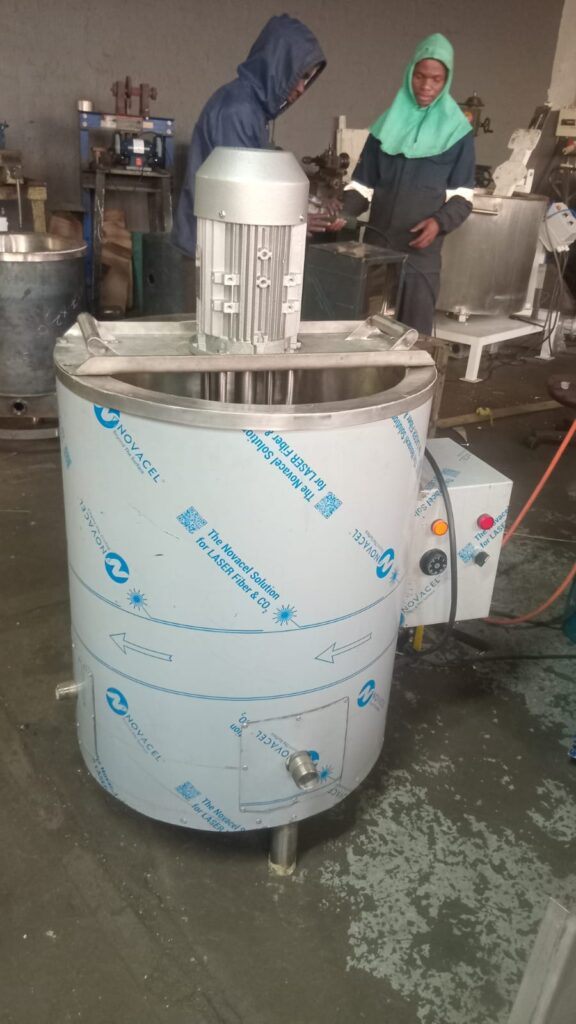
A jacketed homogenizer mixer is one of the most versatile pieces of equipment used in modern manufacturing. Designed to heat, cool, mix, emulsify, and homogenize products within a single vessel, these machines are widely used across the food, cosmetic, pharmaceutical, personal care, and chemical industries.
Businesses that require smooth, uniform, and stable products often rely on jacketed homogenizer mixers to achieve consistent quality while improving production efficiency. Whether producing creams, sauces, lotions, gels, shampoos, or liquid detergents, a homogenizer mixer can significantly enhance product performance and appearance.
What Is a Jacketed Homogenizer Mixer?
A jacketed homogenizer mixer is a processing vessel equipped with a high-shear homogenizing system and an external jacket that allows controlled heating or cooling of the product during production.
The homogenizer breaks down particles and droplets into extremely fine sizes, while the jacket maintains precise temperature control throughout the manufacturing process.
This combination allows manufacturers to produce smooth and stable products with improved texture, consistency, and shelf life.
How Does a Jacketed Homogenizer Mixer Work?
The machine combines several functions within a single system.
Heating and Cooling
The jacket surrounding the mixing tank circulates hot water, steam, or cooling fluid to maintain the desired processing temperature.
Mixing
Agitators continuously blend ingredients to ensure uniform distribution throughout the batch.
Homogenization
A high-speed homogenizer creates intense shear forces that reduce particle size and produce a smooth, uniform product.
Emulsification
Oil and water-based ingredients are blended into stable emulsions that resist separation.
These processes occur simultaneously, allowing for efficient and consistent production.
Industries That Use Jacketed Homogenizer Mixers
Cosmetic Manufacturing
Cosmetic companies use homogenizer mixers to produce:
- Face creams
- Body lotions
- Moisturisers
- Serums
- Hair conditioners
- Sunscreens
Food Processing
Food manufacturers commonly produce:
- Sauces
- Mayonnaise
- Salad dressings
- Dairy products
- Syrups
- Beverage concentrates
Pharmaceutical Manufacturing
Pharmaceutical companies use homogenizers for:
- Medicated creams
- Ointments
- Gels
- Liquid formulations
Chemical Manufacturing
The machines are also suitable for producing:
- Liquid detergents
- Cleaning chemicals
- Industrial emulsions
- Adhesives
- Specialty chemical products
Benefits of a Jacketed Homogenizer Mixer
Superior Product Consistency
Homogenization creates a smooth and uniform product that improves quality and appearance.
Improved Product Stability
Smaller particle sizes help prevent separation and extend shelf life.
Faster Production
Combining multiple processes into a single machine reduces production time.
Precise Temperature Control
The jacketed system allows accurate heating and cooling throughout processing.
Reduced Labour Costs
Automation reduces manual intervention and increases productivity.
Versatile Applications
A single machine can handle a wide range of products and formulations.
Key Features to Look For
When selecting a jacketed homogenizer mixer, consider the following features:
Stainless Steel Construction
Food-grade stainless steel provides durability, corrosion resistance, and easy cleaning.
High-Shear Homogenizer
A powerful homogenizing system ensures excellent particle size reduction.
Jacketed Heating System
Allows efficient temperature control for sensitive formulations.
Variable Speed Controls
Provides flexibility for different product types and viscosities.
Vacuum Mixing Capability
Vacuum systems help eliminate air bubbles and improve product appearance.
Automated Control Panel
Modern control systems improve accuracy and simplify operation.
Common Capacities Available
Jacketed homogenizer mixers are available in various sizes to suit different production requirements.
Small Production Units
Suitable for startups, laboratories, and product development.
Medium-Scale Manufacturing
Ideal for growing businesses with regular production requirements.
Large Industrial Systems
Designed for continuous commercial production and high-volume manufacturing.
Choosing the correct capacity ensures efficient operation while supporting future business growth.
Factors That Affect Pricing
Several factors influence the cost of a jacketed homogenizer mixer:
- Tank capacity
- Homogenizer power
- Heating system type
- Vacuum functionality
- Automation level
- Stainless steel grade
- Manufacturing quality
Businesses should focus on long-term reliability, performance, and production requirements rather than simply choosing the lowest-priced option.
Why Manufacturers Invest in Jacketed Homogenizer Mixers
Companies choose these machines because they deliver:
- Consistent product quality
- Improved production efficiency
- Better product stability
- Faster processing times
- Reduced manufacturing costs
- Greater production flexibility
For manufacturers seeking professional-grade production equipment, a jacketed homogenizer mixer is often one of the most valuable investments available.
Conclusion
A jacketed homogenizer mixer is an essential machine for businesses producing creams, lotions, sauces, detergents, pharmaceuticals, and other liquid or semi-liquid products. By combining heating, cooling, mixing, emulsification, and homogenization into a single system, these machines improve efficiency while delivering exceptional product quality.
Whether you are launching a new manufacturing operation or upgrading existing equipment, investing in a quality jacketed homogenizer mixer can help increase productivity, improve consistency, and support long-term business growth.