
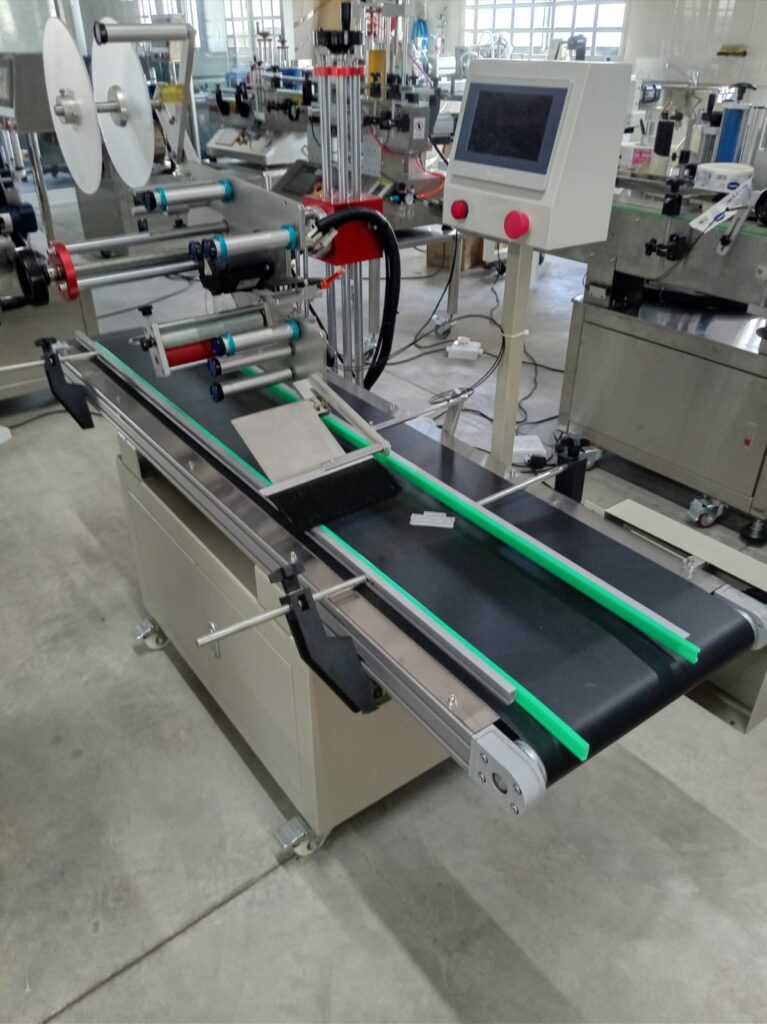
Flat sachets are widely used across industries such as cosmetics, food, pharmaceuticals, and chemicals. Products like shampoo sachets, sauces, powders, and sample packs require accurate and professional labeling for branding and compliance.
A flat sachet labelling machine is specifically designed to apply labels onto flat packaging surfaces such as sachets, pouches, and small bags. These machines improve efficiency, accuracy, and consistency in production.
What is a Flat Sachet Labelling Machine?
A flat sachet labelling machine is a packaging machine used to apply adhesive labels onto flat or flexible packaging materials. These machines ensure precise placement and eliminate manual errors.
Modern machines can achieve high precision with labeling accuracy of around ±1 mm and can handle various label sizes and pouch dimensions.
How the Machine Works
Pouch Feeding
Sachets are fed manually or automatically into the machine depending on the level of automation.
Label Dispensing
Labels are supplied in rolls and released in sync with the machine’s operation.
Label Application
The label is applied using rollers, pressure systems, or air-assisted mechanisms.
Alignment and Finishing
Sensors ensure proper positioning, preventing wrinkles, bubbles, or misalignment.
Advanced machines use PLC control systems and sensors to maintain consistent labeling even on thin or reflective materials.
Types of Flat Sachet Labelling Machines
Manual Machines
- Operated by hand
- Suitable for small-scale production
- Low cost but slower output
Semi-Automatic Machines
- Require minimal operator input
- Provide consistent labeling
- Ideal for small to medium businesses
- Can achieve moderate speeds with high accuracy
Fully Automatic Machines
- High-speed production systems
- Minimal human intervention
- Suitable for industrial-scale manufacturing
- Can label dozens of units per minute continuously
Applications Across Industries
Flat sachet labelling machines are used in:
Cosmetics Industry
Shampoo sachets, skincare samples, creams
Food Industry
Sauces, spices, condiments, instant products
Pharmaceutical Industry
Medicine sachets and powder packs
Chemical Industry
Detergents and cleaning product sachets
Benefits of Using a Flat Sachet Labelling Machine
Professional Branding
Improves product presentation and shelf appeal.
High Efficiency
Speeds up labeling compared to manual processes.
Consistency
Ensures uniform label placement across all products.
Reduced Labor Costs
Automation reduces the need for manual labor.
Production Capacity
Production capacity depends on the machine type:
- Manual machines: low output
- Semi-automatic machines: medium output
- Automatic machines: high output
Some advanced systems can reach speeds of 50–150 sachets per minute depending on configuration.
Factors Affecting Price
The cost of a flat sachet labelling machine depends on:
- Level of automation
- Production speed
- Machine features and technology
- Build quality and materials
Entry-level machines are affordable, while high-speed automated systems require higher investment.
How to Choose the Right Machine
For Startups
Choose manual or entry-level semi-automatic machines for lower cost.
For Growing Businesses
Semi-automatic machines offer a balance between cost and efficiency.
For Industrial Production
Fully automatic machines provide high speed and scalability.
Why Invest in a Flat Sachet Labelling Machine?
- Improves packaging quality
- Enhances brand consistency
- Increases production speed
- Reduces operational costs
- Supports business growth
Conclusion
A flat sachet labelling machine is an essential investment for businesses working with sachets and flat packaging. Whether you operate in cosmetics, food, pharmaceuticals, or chemicals, the right labeling machine ensures efficiency, consistency, and professional results.
Choosing the right machine based on your production needs will help you scale operations and maintain high product quality.
FAQ Section (SEO Optimized)
What is a flat sachet labelling machine used for?
It is used to apply labels onto flat sachets, pouches, and packaging materials.
Can one machine label different sachet sizes?
Yes, most machines are adjustable for different sizes and shapes.
What is the difference between semi-automatic and automatic machines?
Semi-automatic machines require some operator input, while automatic machines run independently.
Is this machine suitable for small businesses?
Yes, manual and semi-automatic machines are ideal for startups and small-scale production.