
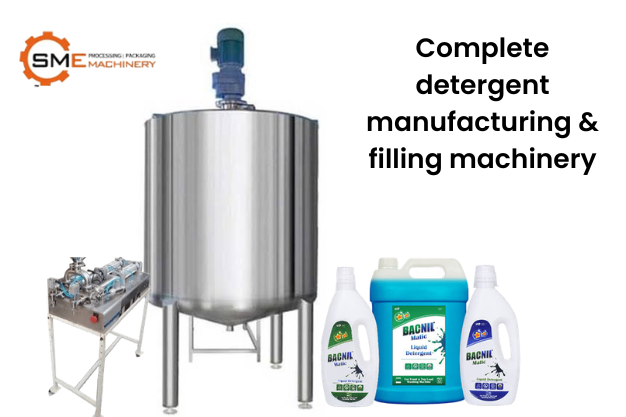
Dishwashing liquid is one of the most in-demand household cleaning products, making it a highly profitable business opportunity. With the right formulation and equipment, manufacturers can produce high-quality dishwashing liquid efficiently and at scale.
Using industrial mixing equipment, businesses can ensure consistent quality, proper blending, and efficient production. This guide explains the complete process of producing dishwashing liquid using industrial machines.
What is Dishwashing Liquid?
Dishwashing liquid is a cleaning solution used to remove grease, food residue, and stains from dishes. It is typically made from a combination of surfactants, water, and additives that enhance cleaning performance and fragrance.
Equipment Needed
To produce dishwashing liquid efficiently, the following equipment is required:
- Industrial mixing tank with agitator
- Homogenizer (optional for smoother consistency)
- Storage tanks
- Filling machine
- Capping and labeling machine
An industrial mixing tank is the core machine, as it ensures all ingredients are properly blended.
Raw Materials Required
The typical ingredients used in dishwashing liquid production include:
- Water (main base)
- Surfactants (cleaning agents)
- Salt (thickening agent)
- Fragrance
- Color
- Preservatives
The formulation can be adjusted depending on product quality and target market.
Step-by-Step Production Process
Step 1: Water Preparation
Fill the industrial mixing tank with the required amount of clean water. Water acts as the base for the solution.
Step 2: Adding Surfactants
Slowly add surfactants into the tank while mixing. This is the main cleaning component that removes grease and dirt.
Step 3: Mixing Process
Use the agitator to mix the solution thoroughly. Maintain a steady mixing speed to avoid excessive foam formation.
Step 4: Thickening
Add salt gradually to increase viscosity. This step controls the thickness of the dishwashing liquid.
Step 5: Adding Additives
Add fragrance, color, and preservatives to enhance the product’s appearance and shelf life.
Step 6: Homogenization (Optional)
Use a homogenizer to achieve a smooth and uniform texture.
Step 7: Quality Check
Check the consistency, pH level, and appearance of the product to ensure it meets quality standards.
Step 8: Filling and Packaging
Transfer the finished product into bottles using a filling machine. Seal and label the containers for distribution.
Key Production Tips
Avoid Excess Foam
Mix at controlled speeds to prevent foaming during production.
Use Quality Raw Materials
High-quality ingredients improve cleaning performance and customer satisfaction.
Maintain Proper Ratios
Incorrect formulation can affect product performance and consistency.
Ensure Hygiene
Clean equipment thoroughly before and after production.
Benefits of Using Industrial Mixing Equipment
Consistent Quality
Ensures uniform mixing across all batches.
High Efficiency
Reduces production time and increases output.
Scalability
Suitable for both small and large-scale production.
Reduced Labor
Automation minimizes manual work.
Production Capacity
Depending on the size of the mixing tank:
- Small tanks (100L – 300L): suitable for startups
- Medium tanks (300L – 1000L): suitable for growing businesses
- Large tanks (1000L+): ideal for industrial production
Cost of Production
Production costs depend on:
- Raw material prices
- Equipment capacity
- Labor and operational costs
Using industrial equipment helps reduce long-term costs by improving efficiency.
Why Start a Dishwashing Liquid Business?
- High demand in households and businesses
- Low startup cost compared to other industries
- Easy to scale production
- Opportunity for branding and product differentiation
Conclusion
Producing dishwashing liquid using industrial mixing equipment is an efficient and profitable process. With the right formulation and machinery, businesses can produce high-quality cleaning products that meet market demand.
By following proper mixing procedures and maintaining quality standards, manufacturers can build a successful and scalable detergent business.
FAQ Section (SEO Optimized)
What machine is used to make dishwashing liquid?
An industrial mixing tank with an agitator is the main machine used.
Can I produce dishwashing liquid on a small scale?
Yes, small mixing tanks are suitable for startup production.
What is the main ingredient in dishwashing liquid?
Surfactants are the primary cleaning agents.
Is dishwashing liquid production profitable?
Yes, due to constant demand and relatively low production costs.