
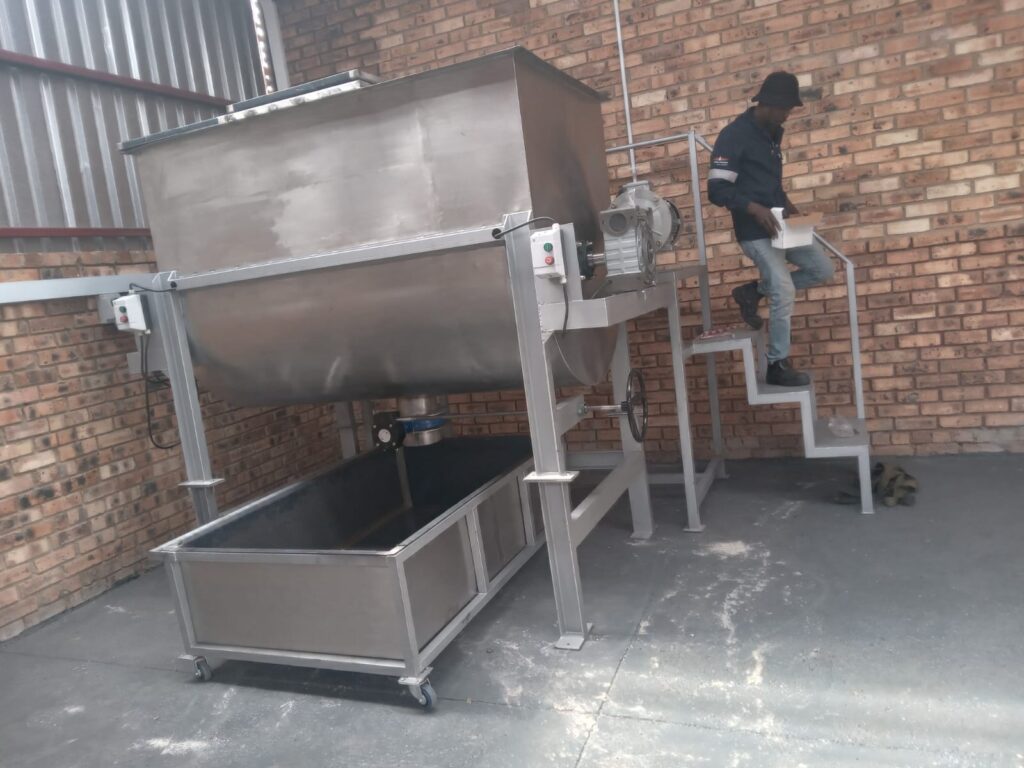
If you are planning to purchase or manufacture a ribbon blender, one of the most critical technical calculations is capacity. Incorrect capacity estimation leads to underperformance, poor mixing uniformity, motor overload, or inefficient production cycles.
This guide explains:
- How ribbon blender capacity is calculated
- Difference between total volume and working volume
- How to calculate batch size in kg
- Formula for capacity calculation
- How density affects ribbon blender capacity
- Practical example calculations
- Motor size considerations
What Is Ribbon Blender Capacity?
Ribbon blender capacity refers to:
- Total Geometric Volume (L or m³) – The full internal volume of the trough
- Working Capacity (Effective Volume) – The actual usable mixing volume
- Batch Capacity (kg) – The mass of product mixed per batch
⚠️ Important: A ribbon blender is typically filled only 40%–70% of its total volume for optimal mixing efficiency.
Step 1: Calculate Total Volume of the Ribbon Blender
Most ribbon blenders have a U-shaped trough. For industrial calculations, we approximate the tank as:
- Semi-cylinder bottom
- Rectangular top section
Basic Volume Formula (Simplified)
If the tank is approximated as a full cylinder:V=π×(D2÷4)×L
Where:
- V = Volume (m³)
- D = Diameter (m)
- L = Length (m)
If U-shaped, use:V=(π×R2÷2)×L+(Rectangular volume)
For practical factory estimation, manufacturers often provide geometric volume based on CAD measurements.
Step 2: Calculate Working Capacity
Ribbon blenders do NOT operate at 100% volume.
Standard Fill Level:
- Minimum: 40%
- Optimal: 50–65%
- Maximum: 70%
Working Volume=Total Volume×Fill Percentage
Example:
If total volume = 2 m³Working Volume=2×0.6=1.2m3
Step 3: Convert Volume to Batch Capacity (kg)
This is where bulk density becomes critical.Batch Capacity(kg)=Working Volume(m3)×Bulk Density(kg/m3)
Understanding Bulk Density
Different materials have different densities:
| Material | Approx Bulk Density (kg/m³) |
|---|---|
| Washing powder | 300–600 |
| Flour | 500–600 |
| Cement | 1200–1500 |
| Chemical powders | 400–900 |
| Spices | 250–500 |
Example Calculation (1000 kg Ribbon Blender)
Assume:
- Total volume = 1.8 m³
- Fill level = 60%
- Bulk density = 900 kg/m³
Step 1:
WorkingVolume=1.8×0.6=1.08m3
Step 2:
BatchCapacity=1.08×900=972kg
≈ 1000 kg ribbon blender
Example: 2000 kg Ribbon Blender
If bulk density = 1000 kg/m³
Required working volume:2000÷1000=2m3
If fill level = 60%TotalVolume=2÷0.6=3.33m3
So, the ribbon blender should have approximately 3.3–3.5 m³ total volume.
Motor Size Calculation (General Industrial Guideline)
Motor size depends on:
- Material density
- Viscosity
- Mixing resistance
- Batch size
Typical motor sizes:
| Capacity | Motor Power |
|---|---|
| 100 kg | 2.2 – 3 kW |
| 500 kg | 7.5 – 11 kW |
| 1000 kg | 15 – 22 kW |
| 2000 kg | 30 – 45 kW |
⚠️ Higher density materials require larger motors.
Formula Summary
1️⃣ Total Volume
V=π×(D2÷4)×L
2️⃣ Working Volume
Working Volume=Total Volume×0.5 to 0.7
3️⃣ Batch Capacity (kg)
Capacity=Working Volume×Bulk Density
Why Correct Capacity Calculation Matters
✔ Prevents motor overload
✔ Ensures proper mixing uniformity
✔ Improves production efficiency
✔ Reduces power consumption
✔ Extends machine lifespan
Common Mistakes When Calculating Ribbon Blender Capacity
❌ Using total volume instead of working volume
❌ Ignoring bulk density
❌ Overfilling above 70%
❌ Under-sizing motor
❌ Not considering future production scale