
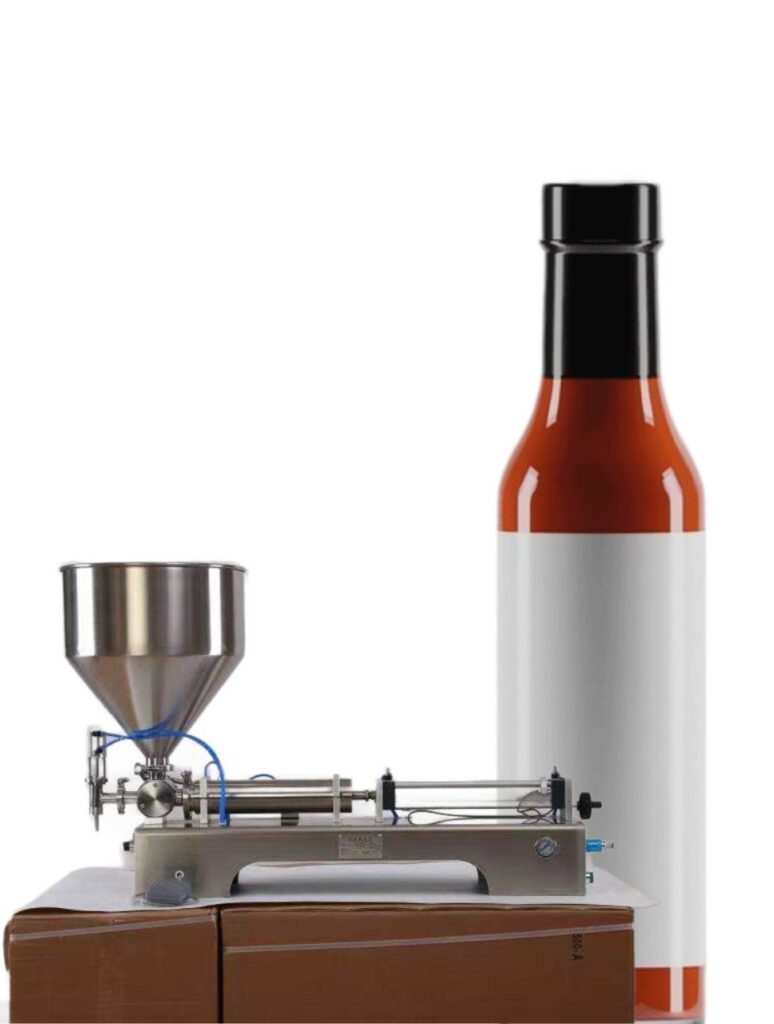
What Affects the Price of a Sauce Filling Machine
When you shop for a sauce filling machine, the price depends strongly on:
- Level of automation (manual/semi-automatic vs fully automatic)
- Filling capacity and speed (small batch vs industrial volume)
- Type of filling mechanism (pump, piston, gear pump, etc.), especially for thick or viscous sauces
- Material quality (food-grade stainless steel vs cheaper metals)
- Number of nozzles / heads (single-head vs multi-head for high output)
- Adjustable fill-volume range and container size flexibility
- New vs used condition — used machines tend to be cheaper but may need maintenance or parts replacement
Typical Price Ranges (Approximate)
| Machine Type / Use Case | Typical Price Range* |
|---|---|
| Entry-level / manual or simple semi-automatic (small-batch or startup scale) | Low to moderate — budget-friendly for small producers |
| Mid-range semi-automatic or small fully-automatic fillers (medium throughput, flexible containers) | Moderate to mid-high — balances cost and performance |
| High-capacity or multipurpose fillers (larger volume, multiple sizes, automation) | Higher end — for commercial-scale operations |
| Fully automatic production-line fillers (high output, multi-head, heavy-duty build) | Premium range — for large-scale bottling or industrial producers |
*Actual prices vary depending on region, supplier, features, and new vs second-hand.
What to Expect at Different Budget Levels
- Lower budget / small-batch machines: Good for sauces, jams, or condiments produced in smaller quantities. Reliable but slower output and basic features.
- Mid-range machines: Better throughput, more reliable pumps, adjustable fill volumes, and compatible with more container sizes — ideal for growing small- to medium-scale businesses.
- High-capacity machines: Built for heavy or frequent use. Offers faster filling, better consistency, more durability — suited for commercial sauce producers.
- Full production-line solutions: Handles very large batches, high throughput, minimal manual work — suited for large factories or big-scale operations.
Why Price Range Varies So Much
- The harder the sauce (thicker or with chunks), the more robust the filler needs to be — stronger pumps or pistons, which cost more.
- Machines designed for many container sizes or fill volumes have more adjustable parts, adding complexity and cost.
- Food-grade materials, sanitary construction, and easy-clean design add to cost, but are necessary for food safety.
- Automating operations (labeling, capping, conveyor integration) increases the overall cost compared to a basic filler.
How to Budget Smart When Buying
- Estimate your daily or batch production volume, so you pick a machine that matches your real needs (not over- or under-capacity).
- Choose a machine built for the viscosity and consistency of your sauce (thin, thick, chunky, etc.).
- Factor in maintenance, cleaning, spare parts — a cheaper machine may cost more long-term if it needs frequent repairs.
- If starting small, consider semi-automatic or simpler fillers — these are more budget-friendly and can serve until business scales.
- Look for versatility — adjusting to different container sizes or bottle types saves future re-investment when expanding product lines.
Final Thoughts
When looking at sauce filling machine price, there isn’t a one-size-fits-all cost. The right machine for you depends on your production volume, sauce type, container types, and how fast you want to grow.
- For small-batch or startup producers — a simpler, lower-cost machine might be enough.
- For growing businesses — a mid-range filler offers balance between price and production capacity.
- For commercial-scale production — a robust, well-built, possibly automated filler might be worth the investment.
Choosing a machine that matches your business size and growth plan is more important than simply buying the cheapest or most expensive option.