
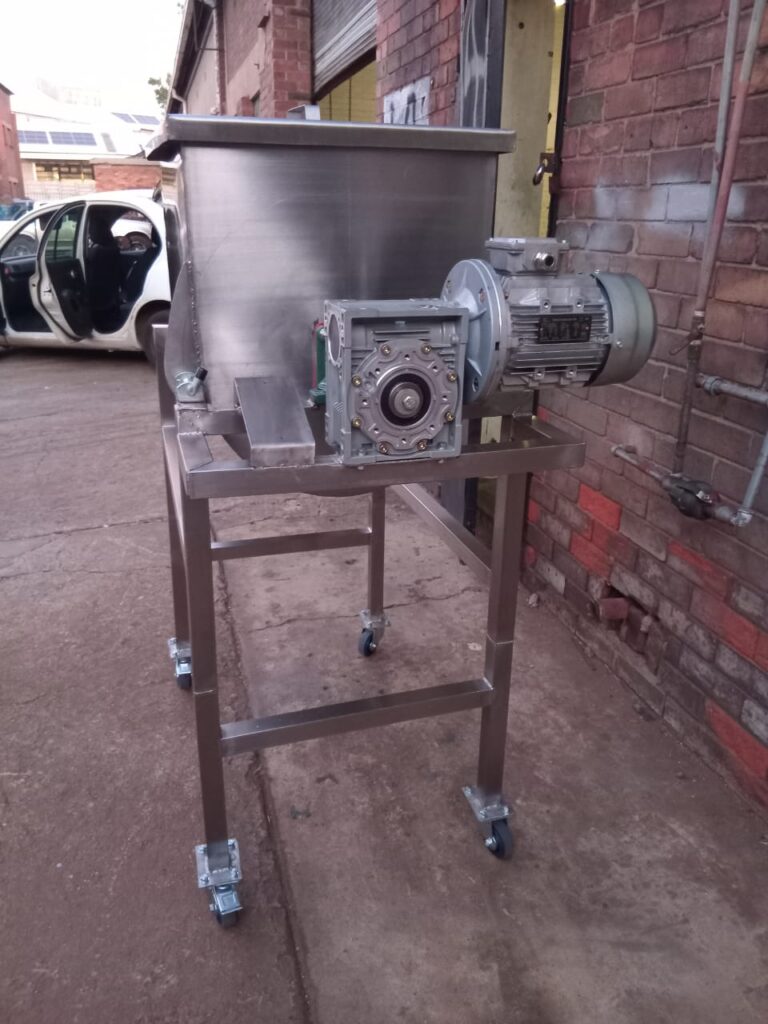
A ribbon blender is one of the most essential machines for any business that mixes powders, granules, spices, detergents, flour, or cosmetic ingredients. If you’re a South African manufacturer looking to improve consistency, speed, and product quality, investing in a ribbon blender is a game-changer.
This guide gives you everything you need to know before buying a ribbon blender for sale in South Africa — including price ranges, applications, features, and how to choose the right model for your production line.
What Is a Ribbon Blender?
A ribbon blender is an industrial mixing machine designed with two helical “ribbon-style” blades — one rotates outward, the other rotates inward. This creates a perfect cross-mixing effect, ensuring even distribution of ingredients in a short amount of time.
It is widely used for:
- Spices
- Protein powders
- Flour & baking mixes
- Detergent powders
- Fertilizer blends
- Cosmetic powders
- Pharmaceuticals
- Food seasoning blends
The ribbon movement gives fast, consistent mixing without damaging the texture of delicate powders.
Why South African Businesses Use Ribbon Blenders
✅ Fast and Uniform Mixing
Guaranteed consistency across every batch.
✅ Handles Multiple Powder Types
From light spices to heavy detergent granules.
✅ Affordable to Maintain
Low energy usage + long-lasting stainless steel body.
✅ Large Capacity Options
From small 50kg units to massive 1000kg industrial blenders.
✅ Improves Production Quality
Retail-ready results with zero clumping.
Ribbon Blender Sizes Available in South Africa
Typical available capacities:
- 50kg – small spice or supplement producers
- 100kg – 200kg – bakeries & small factories
- 300kg – 500kg – detergent manufacturers
- 1000kg+ – full industrial production
The right size depends on:
✔ Your batch size
✔ Your production frequency
✔ Level of business growth
✔ Powder density and type
South African Price Range (2026)
The price of a ribbon blender depends on capacity, material, motor strength, and whether it includes extras like automatic discharge.
Approximate South African pricing:
- 50kg: R18 000 – R28 000
- 100kg: R25 000 – R45 000
- 200kg: R35 000 – R65 000
- 300kg – 500kg: R55 000 – R120 000
- 1000kg+: R120 000 – R220 000
Stainless steel 304 and 316 models cost more but offer better hygiene and durability.
Best Features to Look for in a Ribbon Blender
To ensure you buy a high-quality unit, check for the following:
🔹 Full Stainless Steel Construction
304 for food and cosmetics, 316 for chemical resistance.
🔹 Heavy-Duty Motor
Essential for detergent and fertilizer production.
🔹 Safety Lock Mechanism
Prevents accidents during operation.
🔹 Gearbox Protection
Ensures longevity for high-volume mixing.
🔹 Easy Clean-Out Door
Important for switching between product types.
🔹 Optional Loading Hopper
Speeds up the production process.
🔹 Automatic or Manual Discharge Valve
Helps control the flow of final product.
Industries in South Africa That Use Ribbon Blenders
Ribbon blenders are popular in:
- Powder detergent manufacturing
- Spice & seasoning production
- Supplement & protein powder companies
- Chemical manufacturing
- Cosmetic powder lines
- Bakeries & food processing plants
- Fertilizer blending
- Pharmaceutical mixing
If accuracy, consistency, and hygiene matter, a ribbon blender is the ideal machine.
Why a Ribbon Blender Is Better Than Hand Mixing
Many start-ups in South Africa begin by mixing manually — but it leads to:
❌ Inconsistent final product
❌ Slow production
❌ Employee fatigue
❌ Clumping inside powder
❌ Difficulty scaling up
A ribbon blender solves all these problems with:
✔ Faster mixing
✔ Even distribution
✔ Better product quality
✔ Higher output
✔ Lower labour costs
How to Choose a Reliable Supplier in South Africa
Before purchasing a ribbon blender, ensure the supplier offers:
✔ Warranty
✔ Spare parts availability
✔ Stainless steel material verification
✔ Load testing before delivery
✔ Custom capacity options
✔ Local support for repairs
✔ Clear motor and gearbox specifications
A reputable supplier will always allow you to view or test the machine before buying.
Maintenance Tips to Make Your Blender Last Longer
- Clean after every batch
- Lubricate the gearbox regularly
- Avoid overloading
- Inspect motors and bearings monthly
- Replace worn seals immediately
Proper care ensures your ribbon blender runs for 10+ years with minimal issues.
Ribbon Blender Specifications: What to Check Before You Buy
When comparing a ribbon blender for sale in South Africa, look past the headline capacity. Two machines sold as “500kg” can perform very differently. These are the specifications that matter:
| Specification | Why it matters |
|---|---|
| Working capacity vs trough volume | A ribbon blender mixes best when filled to about 40–70% of its total volume. Size the machine on your batch weight and your powder density. |
| Motor power (kW) and gearbox | Dense products like detergent, cement additives and fertiliser need more torque than spices or flour. |
| Steel grade | 304 stainless steel for food, spices and cosmetics; 316 for salty, acidic or chemical products; mild steel for non-food bulk mixing. |
| Ribbon design | Double (inner and outer) ribbons move product in opposite directions for a faster, more even mix. |
| Discharge valve | A centre bottom discharge (manual or pneumatic) empties the trough quickly and cleanly. |
| Shaft seals | Good seals stop fine powder leaking into the bearings, which is the most common cause of breakdowns. |
| Liquid spray nozzles (optional) | Needed if you add oils, fragrance or liquid binders to a powder blend. |
Ribbon Blender vs Paddle Mixer: Which One Do You Need?
A ribbon blender and a paddle mixer look similar, but they suit different products:
- Ribbon blender: best for dry, free-flowing powders and granules such as spices, washing powder, flour, protein powder and premixes. Fast, even, gentle mixing.
- Paddle mixer: better for heavier, wetter or fragile products such as boerewors mince, animal feed with molasses, or ingredients that should not be crushed.
- Paddle-ribbon combination: a hybrid agitator for products that sit in between.
If you are unsure, send us your recipe and batch size and we will recommend the right agitator. See our full ribbon blender and paddle mixer machinery range, or the vertical ribbon blender if floor space is tight.
Ribbon Blender Prices by Capacity
The ribbon blender price depends mostly on capacity, steel grade and motor size. For detailed guides on specific sizes, see:
- 500kg ribbon blender mixer for sale – the most popular size for growing detergent and spice producers
- 1000kg (1 ton) ribbon blender for sale – for full-scale factory production
- 2000kg ribbon blender mixer – for high-volume industrial plants
Because SME Machinery builds to order, we can also make in-between sizes such as 100kg, 200kg or 300kg units for start-ups.
New vs Used Ribbon Blender for Sale in South Africa
A used ribbon blender for sale can look cheaper up front, but older machines often have worn shaft seals, tired gearboxes and mild steel parts that are not suitable for food. Before you buy second-hand, check the seals, ribbon clearance, motor rating and steel grade. Read our guide to buying a second-hand ribbon blender in South Africa.
A new, locally built ribbon blender is made to your batch size, comes with spare parts support from a local factory, and can be paid off with rent-to-own finance, which often closes the price gap with a used machine.
Buying a Ribbon Mixer Near You in Gauteng
SME Machinery is a ribbon blender manufacturer in South Africa, based in Germiston on the East Rand. Customers in Johannesburg, Pretoria, Centurion, the Vaal Triangle and the West Rand can visit the factory to see a ribbon mixer running before they buy. We also deliver and install nationwide. See our service areas across Gauteng.
Frequently Asked Questions
How much does a ribbon blender cost in South Africa?
Small 50–100kg ribbon blenders start at around R18 000–R45 000, while 500kg to 1 ton industrial machines range from about R55 000 to R220 000, depending on steel grade, motor and options. Contact us for an exact quote on your size.
What is a ribbon blender used for?
Ribbon blenders mix dry powders and granules evenly, for example spices and seasonings, washing powder, flour and baking premixes, protein and supplement powders, animal feed premixes, fertiliser and cosmetic powders.
What size ribbon blender do I need?
Work out the weight of one batch and your powder density. The machine should be filled to about 40–70% of its volume. If you mix 200kg per batch of a light powder, you will usually need a larger trough than for 200kg of a dense detergent.
Can a ribbon blender mix liquids into powder?
Yes. With spray nozzles fitted above the ribbons, small amounts of oil, fragrance or liquid binder can be added evenly to a powder blend.
Do you sell used ribbon blenders?
Our focus is new, made-to-order machines with local support. Rent-to-own finance makes a new ribbon blender affordable for start-ups that would otherwise consider second-hand.
How long does it take to build a ribbon blender?
Lead times depend on size and current orders. Contact us with your requirements for a delivery estimate.
Get a Quote on a Ribbon Blender from SME Machinery
SME Machinery designs and manufactures ribbon blenders to your specification at our factory in Germiston, and we deliver and install across Gauteng and South Africa. Tell us what you produce, your batch size and your daily output, and we will recommend the right machine and send you a quote.
- Call or WhatsApp: 073 646 5211
- Email: info@smemachinery.co.za
- Visit: 8 Moller Street, Factory C2, Germiston South (Mon–Sat, 7am–5pm)
- Need to spread the cost? See our rent-to-own and finance options.
Conclusion
A ribbon blender for sale in South Africa is a powerful and essential investment for any powder-based production business. Whether you’re mixing spices, detergent, supplements, or chemicals, this machine helps you achieve consistent quality, faster production, and professional-grade results.
For South African manufacturers aiming to scale in 2026 and beyond, a ribbon blender isn’t just useful — it’s a necessity.