
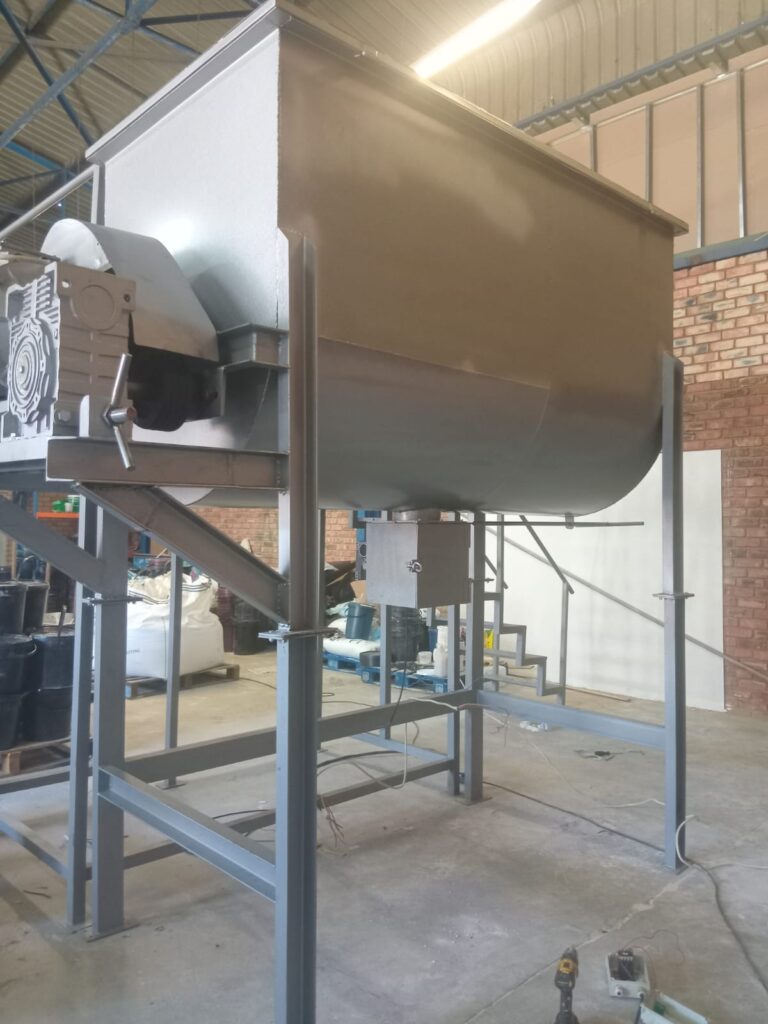
If you are searching for a reliable ribbon blender manufacturer, you need more than just a machine supplier. You need a production partner that understands mixing technology, material behavior, motor engineering, and industrial durability.
This comprehensive guide explains:
- What a ribbon blender manufacturer should offer
- Types of ribbon blenders
- Technical specifications
- Motor sizes & batch capacities
- Industries served
- Customization options
- Pricing factors
- How to choose the right manufacturer
What Does a Ribbon Blender Manufacturer Do?
A professional ribbon blender manufacturer designs, fabricates, and tests industrial mixing machines used for blending powders, granules, and low-viscosity materials.
A quality manufacturer provides:
- Custom capacity design (100 kg – 5000 kg+)
- Heavy-duty carbon steel or stainless steel construction
- Precision-engineered double ribbon agitators
- Proper motor and gearbox selection
- Food-grade or pharmaceutical compliance (if required)
- After-sales support and spare parts
Types of Ribbon Blenders Manufactured
1️⃣ U-Trough Horizontal Ribbon Blender
Most common industrial model featuring:
- U-shaped trough
- Double helical ribbon agitator
- Central discharge valve
- Bottom outlet
Used for powders, chemicals, detergents, and food mixing.
2️⃣ Jacketed Ribbon Blender
Includes heating or cooling jacket for:
- Drying
- Temperature-sensitive mixing
- Chemical processing
- Food processing
3️⃣ Vacuum Ribbon Blender
Designed for:
- Pharmaceutical powders
- Fine chemical blending
- Oxidation-sensitive materials
Ribbon Blender Technical Specifications
A professional ribbon blender manufacturer typically offers:
| Specification | Range |
|---|---|
| Capacity | 100 kg – 5000 kg |
| Volume | 200L – 10,000L |
| Motor Power | 2.2 kW – 55 kW |
| Material | Mild Steel / SS304 / SS316 |
| Mixing Time | 5 – 20 minutes |
| Discharge | Pneumatic / Manual / Screw |
Motor Sizes & Batch Capacities
Motor power depends on density and resistance.
| Batch Size | Motor Size |
|---|---|
| 100 kg | 2.2 – 3 kW |
| 500 kg | 7.5 – 11 kW |
| 1000 kg | 15 – 22 kW |
| 2000 kg | 30 – 37 kW |
| 5000 kg | 45 – 55 kW |
A reliable ribbon blender manufacturer calculates motor torque based on:
- Bulk density
- Load factor
- Ribbon pitch
- Gear reduction ratio
Industries Served
A professional ribbon blender manufacturer supplies to:
- Chemical industry
- Pharmaceutical industry
- Food processing industry
- Detergent manufacturing
- Cosmetic production
- Construction material manufacturing
- Fertilizer production
Customization Options
Leading manufacturers provide:
- Explosion-proof motors
- PLC automation control panels
- Variable Frequency Drive (VFD)
- Load cell weighing systems
- Liquid spray nozzles
- Stainless steel polishing (food-grade finish)
- Dust-proof sealing systems
How to Choose the Right Ribbon Blender Manufacturer
1️⃣ Check Engineering Capability
Ask for:
- CAD drawings
- Torque calculations
- Material thickness specifications
2️⃣ Verify Fabrication Quality
Look for:
- Full weld penetration
- Heavy-duty shaft alignment
- Balanced agitator design
3️⃣ Confirm After-Sales Support
- Spare parts availability
- Installation guidance
- Technical support
4️⃣ Evaluate Experience
A manufacturer with multiple industry projects is more reliable than a reseller.
Ribbon Blender Price Factors
Prices vary depending on:
- Capacity
- Material grade (MS vs SS304 vs SS316)
- Motor brand
- Automation level
- Jacketed or non-jacketed
- Customization requirements
Typical price ranges:
- Small scale: Entry-level pricing
- Medium scale: Mid industrial pricing
- Large scale: Heavy industrial investment
(Exact prices depend on region and specifications.)
Why Work with a Professional Ribbon Blender Manufacturer?
✔ Better mixing uniformity
✔ Higher production efficiency
✔ Reduced energy consumption
✔ Long service life
✔ Proper torque calculation
✔ Safer operation