
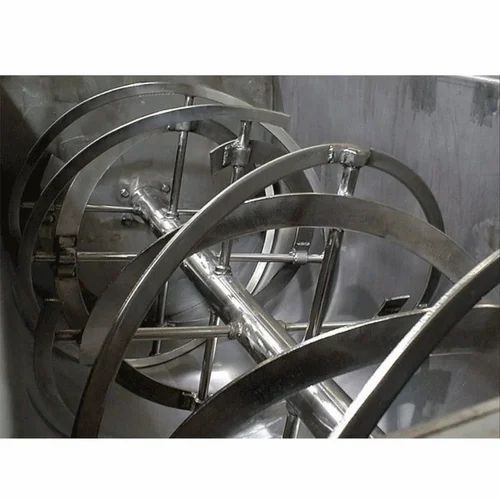
What Is a Paddle Mixer?
A paddle mixer is a mixing machine that uses rotating paddles inside a trough or chamber to stir, mix, or blend powders, granules, or light solids — sometimes even viscous materials or slurries. It’s commonly used in industries such as detergents, feed, chemicals, pharmaceuticals, and small-batch manufacturing.
For smaller producers — startups, SMEs, artisanal manufacturers — a small paddle mixer offers a cost-effective way to blend powders or semi-dry materials without needing large industrial-scale equipment.
Why Choose a Small Paddle Mixer?
- Compact size & lower cost: Easier to accommodate in small workshops, factories, or production rooms compared to large mixing tanks.
- Flexibility: Ideal for small-batch production, pilot runs, specialty blends, or seasonal/limited-volume manufacturing.
- Lower maintenance & easier cleaning: Smaller units tend to be easier to clean, maintain, and disassemble for sanitation — useful when changing recipes or materials.
- Efficient mixing for dry powders & granules: Ensures uniform blending of detergents, feed, powders, or other dry mixtures — good for consistent product quality without over-complication.
- Entry-level for small businesses: Great for entrepreneurs or small manufacturers who want to expand output beyond hand-mixing but don’t need full industrial lines yet.
What You Get with a Small Paddle Mixer (Typical Features & Capacity)
Depending on the model and manufacturer, small paddle mixers often come with:
- Paddle shaft with paddles specially shaped for lifting and folding materials for homogeneous mixing.
- A trough or chamber suitable for small-to-medium batches (often from tens to a few hundred litres, depending on model).
- Simple drive system (electric motor + gearbox), sometimes 3-phase or single-phase depending on size/power.
- Discharge outlet or flap for easy emptying of mixed batch.
- Stainless steel or mild steel body (for dry powders, though contact material matters if mixing sensitive products).
- Easy access for cleaning — important for hygiene or changing materials.
In many cases, small paddle mixers are ideal for dry-powder mixing, animal feed, detergents, chemicals, powders, granulates, or even prepared mixtures that don’t require heavy shear or high viscosity handling.
Typical Price Range & What to Expect (South Africa & Global Context)
Based on available local machines and small mixer offerings:
- A small-scale batch paddle mixer of roughly 70 L capacity is sometimes listed around R 22,500. Roff Milling
- Mid-level small paddle mixers (higher capacity than lab-scale but still compact) are likely to range moderately higher — depending on capacity, motor power, and build quality.
- For slightly larger but still manageable paddle-mixer units (a few hundred litres), prices increase further — but still remain significantly lower than full industrial mixers.
Because paddle mixers cover a broad capacity and build quality spectrum, you should match price expectations with your actual production needs (volume, material type, batch frequency).
What to Check When Buying a Small Paddle Mixer
To make sure you get good value and suitable performance, check:
- Mixer capacity vs. batch size: Ensure the mixer’s capacity matches the volume you intend to process per batch — avoid overloading or under-utilising.
- Paddle and shaft condition: Look for paddles that are intact, straight, and properly welded, with no visible wear or corrosion.
- Material compatibility: Especially if mixing chemicals, detergents, or powders — check if mixer materials (steel/stainless) are suitable and non-reactive.
- Drive & motor setup: Confirm motor power is adequate for the material density and batch volume; ensure gearbox and drive belt/chain are in good condition.
- Ease of cleaning & maintenance: Access doors, discharge outlets, removable paddles make cleaning easier when switching materials or after use.
- Discharge mechanism: Smooth and complete discharge reduces waste and ensures batch consistency.
- Batch uniformity: Test-run with a sample mix to check how evenly the mixer blends materials — look for clumps or dead zones.
- Local support & spare parts: Especially important for long-term reliability — parts like paddles, seals, shafts should be replaceable locally or easy to custom-fabricate if needed.
Who Should Consider Buying a Small Paddle Mixer?
A small paddle mixer is a good fit for:
- Entrepreneurs and start-ups producing powders, detergents, feed, or small-batch products
- SMEs seeking to scale from manual mixing to mechanised mixing without large capital investment
- Manufacturers of detergent powders, animal feed, fertilizer mixes, powdered chemicals, or dry blends
- Producers needing flexibility — multiple recipes, changing materials, small runs, or experimentation
- Workshops or factories with limited space or limited budget — looking for entry-level industrial equipment
Advantages & Limitations of Small Paddle Mixers
✅ Advantages
- Affordable and budget-friendly for small producers
- Compact footprint — suitable for small workshops/factories
- Versatile across powder blends, granules, dry mixtures
- Easier maintenance and cleaning
- Good for batch flexibility and multiple product lines
⚠️ Limitations
- Not suitable for heavy pastes, high-viscosity slurries or thick creams — paddle mixers are best for dry or lightly blended materials
- Lower throughput compared to large industrial mixers — may limit high-volume production
- Mixing uniformity depends heavily on batch loading (fill %), paddle design, and mixing time — needs careful operation for consistent results
- Manual or semi-automatic operation — some labour involvement remains
Final Thoughts: Is a Small Paddle Mixer Worth It?
If you produce or plan to produce powdered or dry-mixed products — such as detergents, feed, chemicals, powders — and you are at the stage of scaling from manual mixing, a small paddle mixer is often the most cost-effective and practical investment.
It provides consistent mixing, reasonable throughput, manageable overheads, and flexibility for small to medium-size production runs. For many small businesses and startups, it represents a good balance between price, performance, and scalability.
Choose a mixer with the right capacity and build quality — and with proper operation and maintenance, it can serve reliably and help you grow your output without overspending.