
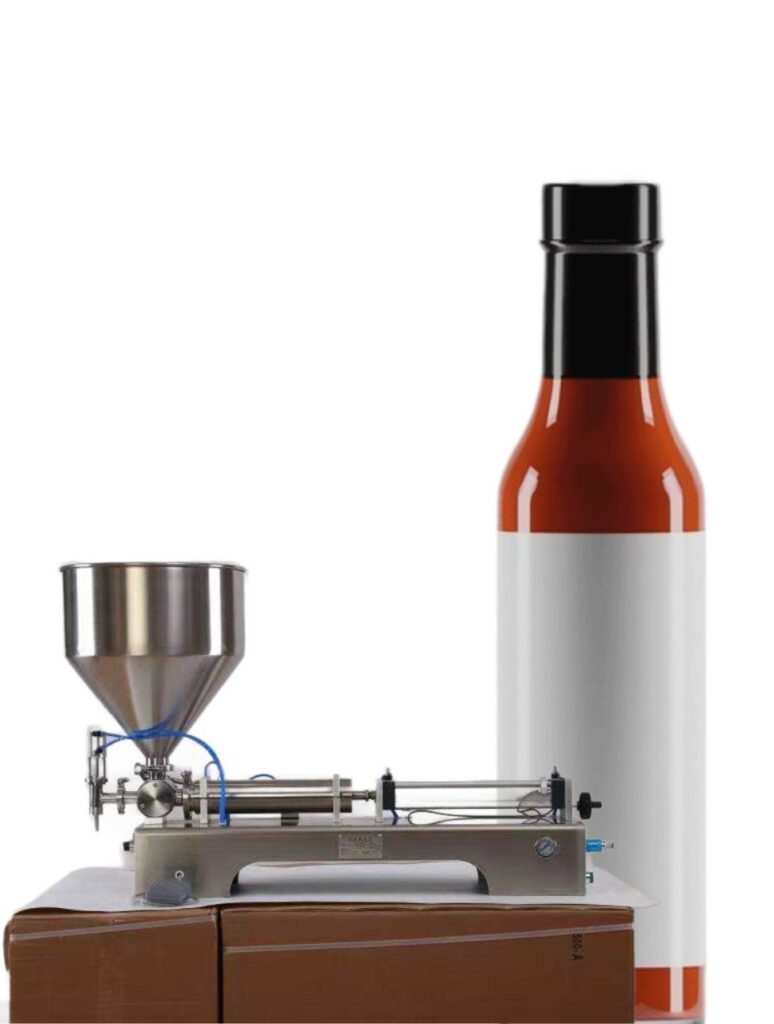
What Is a Sauce Filling Machine?
A sauce filling machine is equipment designed to fill bottles, jars, or containers with sauces, condiments, syrups, or other semi-liquid and viscous products. Because sauces often have thicker consistency than water, the machine uses pumps, pistons, or controlled dispensing nozzles to push the sauce into containers, ensuring consistent volume, minimal spillage, and hygienic handling.
These machines are widely used in food processing — from small artisanal sauce producers to larger commercial bottling operations.
Why Use a Sauce Filling Machine?
✅ Consistent Fill Volume
Manual filling often results in uneven fills or spillage. A sauce filling machine delivers accurate, repeatable fill volumes — important for quality control and regulatory compliance.
✅ Speed & Efficiency
Filling bottles manually is labour-intensive and slow. A filling machine significantly increases throughput, especially if you have high production targets or many orders.
✅ Hygiene & Food Safety
Modern machines are built with food-grade materials, designed for easy cleaning and sanitisation — crucial when dealing with edible products.
✅ Scalability
As your production grows, a filling machine allows you to scale up without proportionally increasing labour. Great for growing sauce, jam, or condiment businesses.
✅ Reduced Waste
Precise filling reduces wastage from overfilling or spillage, saving on raw materials over time.
Types of Sauce Filling Machines
Depending on your production size, sauce viscosity, and container type, you can choose from different machine types:
1. Piston / Positive-Displacement Fillers
- Uses piston action or pump to push sauce into containers.
- Effective for thick sauces, creams, or pasty products.
- Good for small to medium production lines.
2. Gear Pump / Rotary Pump Fillers
- Uses pumps that handle semi-viscous or viscous sauces.
- Can maintain steady flow with thick products.
- Good for sauces with bits or pulp (e.g. chutneys, salsas).
3. Semi-Automatic Fillers
- Bottles are placed manually, machine handles filling and dosing.
- Ideal for SMEs, artisanal producers, and small batch runs.
4. Fully Automatic Filling Lines
- Bottles are fed, filled, and sometimes capped automatically.
- Multi-head fillers for large throughput — suited for larger factories or commercial bottlers.
5. Volumetric Fillers with Nozzle Control
- Controlled dosing of precise volumes — useful when filling different container sizes or recipes.
What to Consider Before Buying a Sauce Filling Machine
When evaluating a sauce filling machine, take into account:
- Viscosity & Texture of Sauce: Thick sauces need stronger pumps or piston systems; sauces with chunks or bits may require special pumps.
- Container Type & Size: Bottles, jars, pouches — match machine with your container shape and volume range.
- Fill Volume Range & Accuracy: Ensure machine can handle min and max volumes needed by your products.
- Cleaning & Hygiene: Machine should be easy to disassemble, clean, and sterilize — especially important for food production.
- Material Contact Parts: Use food-grade stainless steel to avoid contamination or corrosion.
- Production Volume / Throughput Needs: Estimate daily or batch output to pick between semi-automatic and fully automatic machines.
- Power & Maintenance Requirements: Understand motor/pump power, maintenance schedule, and availability of spare parts.
- Budget & ROI: Balance initial cost with increased production speed, labour savings, and waste reduction.
Common Uses & Industries
Sauce filling machines are widely used in:
- Hot sauces, chilli sauces, salsas
- Tomato sauces, pasta sauces
- Barbecue sauces, marinades
- Ketchup, mayonnaise, salad dressings
- Jams, chutneys, preserves
- Nut butters, spreads, peanut butter, almond butter
- Condiments: mustard, relishes
- Specialty food products: flavoured oils, syrups
Both small artisanal producers and large-scale manufacturers benefit from using a sauce filling machine.
Advantages & Challenges
Advantages
- Consistent, accurate filling
- Faster production compared to manual bottling
- Hygienic and suitable for food-grade production
- Scalable — fits small to large operations
- Reduces labour and wastage
Challenges
- Initial cost can be high, especially for automatic machines
- Maintenance and cleaning required, especially with viscous sauces
- For sauces with particles or chunks, may need special pumps or nozzles
- Requires proper training for operators for hygiene and efficiency
Who Should Use a Sauce Filling Machine?
- Small to medium sized food producers looking to increase production speed and consistency
- Start-ups making sauces, jams, condiments, homemade lines
- Factories scaling up from manual bottling to semi-automated lines
- Businesses needing accurate portion control and consistent packaging
- Producers of thick or viscous sauces, pastes, or spreads
Final Thoughts
A sauce filling machine is one of the most valuable investments for businesses that produce sauces, condiments, jams, or other liquid/semi-liquid food products. By automating the filling process, you save time, reduce waste, ensure consistent product quality, and improve hygiene — all of which help you scale up, meet demand, and build a reliable brand.
Before purchasing, carefully consider the viscosity of your sauce, your production needs, hygiene and cleaning requirements, and maintenance capabilities. With the right machine, you’ll position your food business for growth and success.