
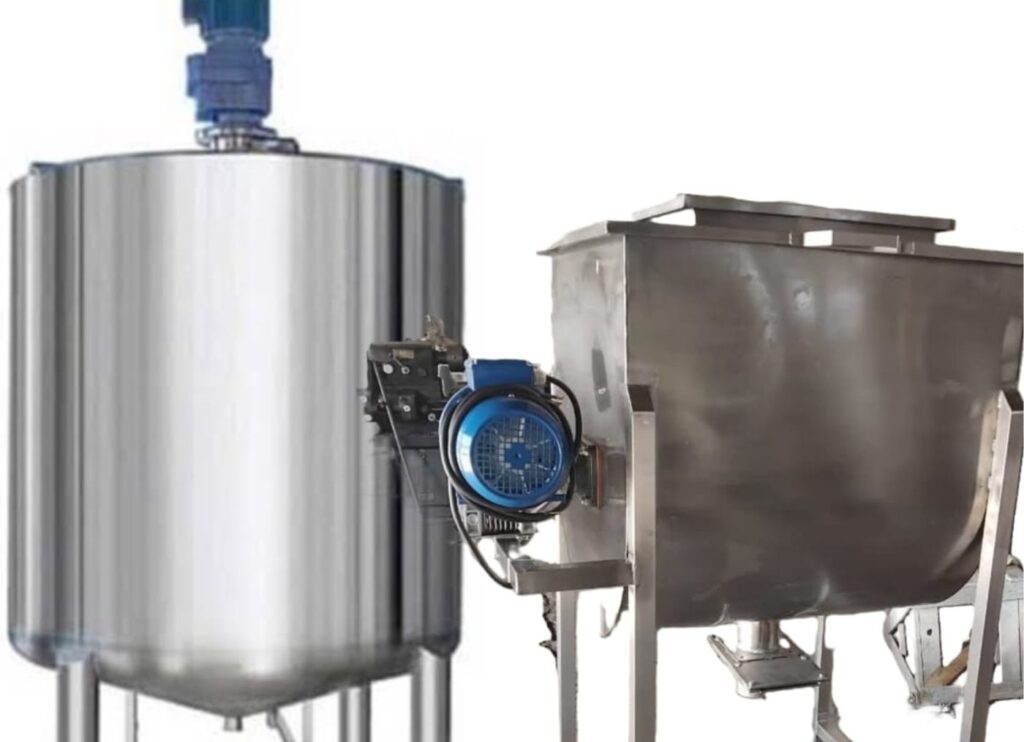
One of the most common questions from first-time manufacturers entering the detergent, cosmetic, or food production space is whether they need a ribbon blender or a mixing tank. The confusion is understandable — both machines mix raw materials into a finished product, both have a motor-driven agitator, and both get referred to loosely as “mixers” in casual conversation.
But they’re built for fundamentally different jobs. Buying the wrong one means either a machine that can’t properly process your product, or money spent on capability you don’t need. This guide breaks down exactly what each machine does, which products need which, and how to decide when your production line needs both.
What a Ribbon Blender Is Built For
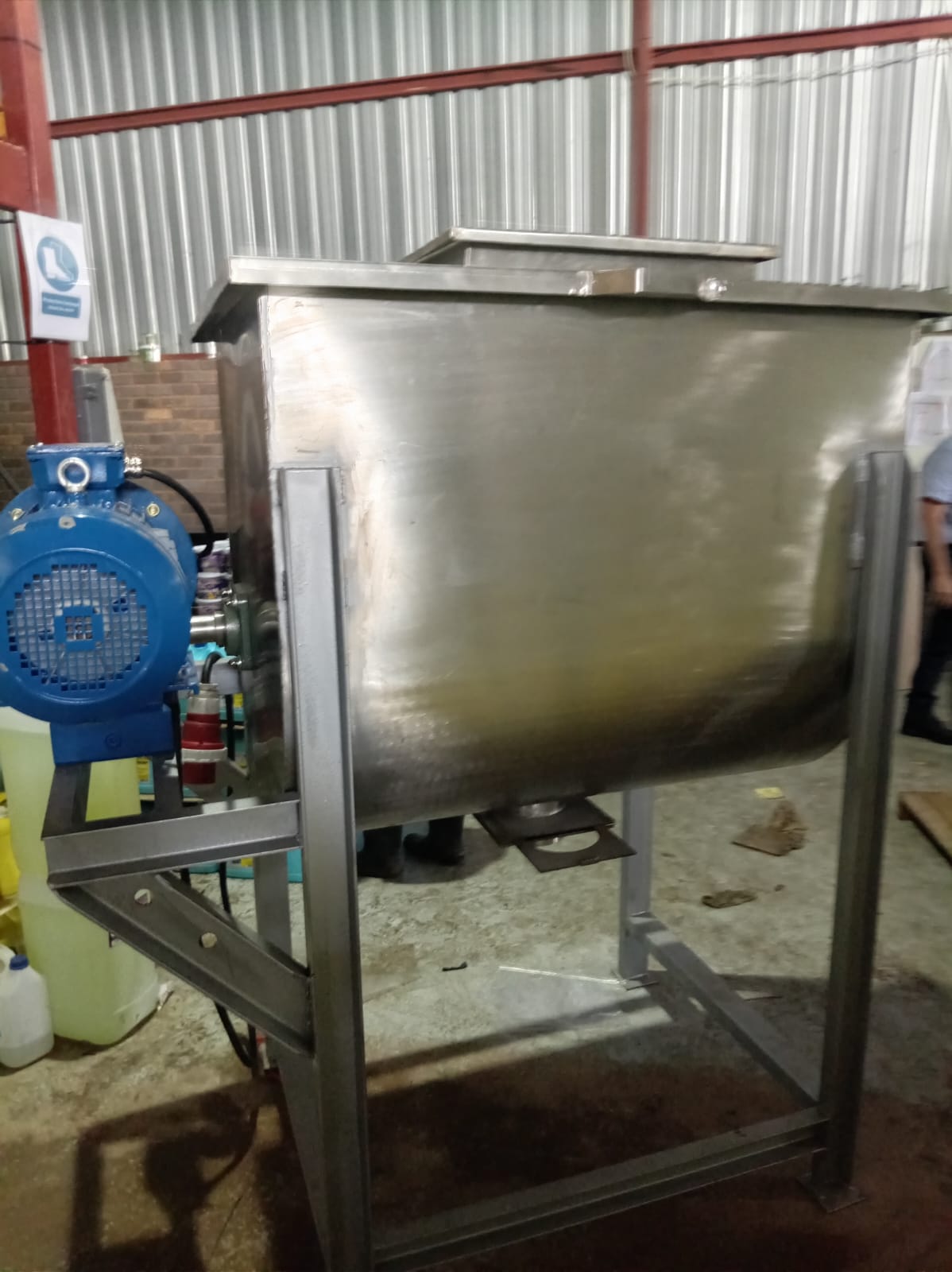
A ribbon blender uses a horizontal trough fitted with a helical ribbon agitator — one or two interlocking spiral blades that continuously fold material from the ends of the trough toward the centre and back out again. This folding action is specifically designed to blend dry powders, granules, and pastes evenly without the aggressive shear a liquid mixer would apply.
Ribbon blenders excel at:
- Powder detergent blending — combining base powder, active surfactant granules, fragrance, and brighteners into a uniform mix
- Spice and food powder blending — flour blends, spice mixes, powdered supplements
- Dry cosmetic and personal care powders — bath salts, powder masks, talc-based products
- Granule and pellet mixing — where particle integrity needs to be preserved, not crushed
The horizontal trough design also makes ribbon blenders relatively easy to discharge — most have a bottom outlet that feeds directly into a bagging or packaging line, which is exactly why they’re commonly paired with weighing and bagging equipment for finished powder products.
What a Detergent Mixing Tank Is Built For
A detergent mixing tank is a vertical vessel, typically cylindrical and stainless steel, fitted with a top-mounted or side-mounted agitator or paddle. Unlike a ribbon blender’s folding action, a mixing tank’s agitator spins to create flow and shear within a liquid — blending water, surfactants, thickeners, and additives into a stable, homogeneous liquid.
Mixing tanks excel at:
- Liquid detergent production — dishwashing liquid, laundry liquid, multi-surface cleaners
- Thickening and viscosity control — the circulating flow pattern is what allows thickening agents to disperse evenly through the liquid without clumping
- Emulsification — blending oil and water-based components into a stable mixture, relevant for creamy or lotion-style cleaning products
- Heat-sensitive formulations — when jacketed, the tank can heat or cool during mixing, which powder blending never requires
Because liquids flow and redistribute on their own to some extent, a mixing tank doesn’t need the same mechanical folding action a dry powder does — a powder left undisturbed just sits in a pile, while a liquid will still partially self-level, which is part of why the two mixing actions are so different.

Key Differences at a Glance
| Feature | Ribbon Blender | Detergent Mixing Tank |
|---|---|---|
| Orientation | Horizontal trough | Vertical tank |
| Agitator type | Helical ribbon blade | Paddle or propeller agitator |
| Mixing action | Folding/tumbling | Flow and shear |
| Best for | Powders, granules, pastes | Liquids, gels |
| Heating/cooling | Not typically used | Available via jacketing |
| Typical discharge | Bottom gate into bagging line | Bottom valve into filling line |
| Common products | Powder detergent, spice blends, dry cosmetics | Liquid detergent, dishwashing liquid, lotions |
Which Products Need Which Machine
The simplest way to decide is to look at the physical state of the product leaving the machine. If it pours, you need a tank. If it scoops, you need a blender.
Choose a ribbon blender for:
- Washing powder and powder detergent, where surfactant powders, soda ash, sodium sulphate and fragrance must be evenly distributed
- Spice blends, seasoning, premixes and other dry food powders
- Dry cosmetic products such as talc blends, bath salts and powdered clays
- Animal feed premixes and fertiliser blends with a small liquid spray-on
Choose a detergent mixing tank for:
- Liquid detergent, dishwashing liquid, fabric softener and multi-purpose cleaners
- Hand soap, shampoo and other gel products (a higher-torque or anchor agitator helps here)
- Lotions and creams, usually in a jacketed tank paired with a homogenizer
- Sauces, syrups and beverages that need heating or holding at temperature
When Your Production Line Needs Both
Many detergent businesses end up running both machines side by side. A typical example is a producer who starts with dishwashing liquid and then adds washing powder to the range. The liquid line runs through a mixing tank into a filling machine, while the powder line runs through a ribbon blender into a bagging or powder filling station.
The two machines don’t replace each other, and trying to force one to do the other’s job causes problems. A tank agitator can’t fold dense powders evenly, so you get pockets of unmixed actives. A ribbon blender can’t build the flow and shear a liquid needs, and its trough isn’t designed to hold liquid without leaking at the shaft seals. If both product types are in your plan, budget for both machines from the start, even if you buy them a few months apart. Our guide on how to start a detergent manufacturing business covers how to phase equipment purchases as your range grows.
How to Choose the Right Machine
Before asking for a quote, have clear answers to these questions:
- What is the product’s final form? Powder, granule, paste, liquid or gel decides the machine type.
- What batch size do you need? Ribbon blenders are sized in kilograms (50kg to 2000kg is the common range), mixing tanks in litres (100L to 2000L).
- Does the product need heat? Thick gels, creams and some liquid soaps need a jacketed tank. Dry powders almost never need heat.
- What is the product made of? Corrosive or food-grade products call for 304 or 316 stainless steel contact parts.
- How will it discharge? Plan the outlet height and valve type so it feeds straight into your filling or bagging step.
For more detail on each side of the decision, see our guides on ribbon blender sizes, liquid detergent manufacturing machines and plastic vs stainless steel mixing tanks.
Frequently Asked Questions
Can a ribbon blender mix liquid detergent? No. A ribbon blender is built to fold dry or semi-dry materials. It can take a small liquid spray-on, such as fragrance or a liquid surfactant added to a powder, but it can’t mix a fully liquid batch.
Can a mixing tank make washing powder? Not properly. A vertical agitator can’t move dense powders evenly through the batch, which leads to inconsistent product and dead spots at the bottom of the tank.
Which machine is cheaper? At similar capacities the prices are broadly comparable. Cost depends mostly on size, motor power, stainless steel grade and extras such as jacketing, so compare quotes on a like-for-like specification rather than on machine type.
Final Thoughts
The rule of thumb is simple: powders go in a ribbon blender and liquids go in a mixing tank. If your product range covers both, you’ll need both. SME Machinery manufactures ribbon blenders and detergent mixing tanks in South Africa, in sizes to suit start-ups and established producers. Contact us with your product and batch size for advice and a quote.