
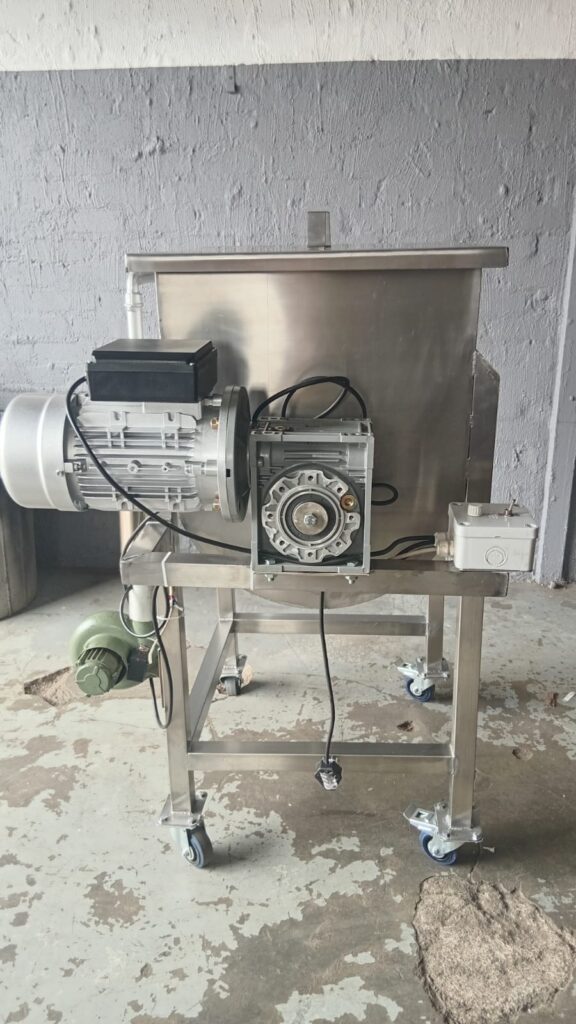
Industrial Detergent Powder Manufacturing Equipment
If you want to establish or scale your washing powder production, the right washing powder making machine is a critical investment. Designed for efficient, consistent, and scalable output, these machines help you transform raw materials into high-quality detergent powder with precision and speed.
This complete guide explains what the machine does, how it works, its key features, price ranges, and how to choose the right system for your business.
What Is a Washing Powder Making Machine?
A washing powder making machine is industrial equipment used to manufacture detergent powder by accurately mixing raw materials into a homogeneous and market-ready product. These machines are part of a complete detergent production system that typically includes weighing, blending, optional liquid addition, and packaging.
This equipment ensures uniform mixing, reduced manual labour, and consistent product quality — essential for brands and contract manufacturers.
How the Washing Powder Making Machine Works
A typical washing powder production line includes:
1. Weighing and Feeding System
Raw materials such as soda ash, sodium sulfate, surfactants, enzymes, builders, and fragrances are accurately measured.
2. Ribbon Blender or Paddle Mixer
Powdered ingredients are blended uniformly to form a consistent base mix.
3. Liquid Spray System (Optional)
Liquid detergents, enzymes, binders, or fragrances are integrated into the dry mix if required.
4. Secondary Mixing
Ensures liquids and solids are fully combined into a single texture.
5. Sieving / Screening Unit
Removes lumps and ensures uniform particle size.
6. Packaging Machine
Finished detergent powder is packed into bags, sacks, or boxes.
Key Machine Components
✔ Heavy-duty industrial ribbon blender or paddle mixer
✔ Accurate weighing & dosing systems
✔ Optional liquid spray system
✔ Sieving or screening unit
✔ Packaging solution (manual to fully automatic)
✔ Stainless steel construction (for hygiene & durability)
Advantages of a Washing Powder Making Machine
Consistent Product Quality
Precise mixing ratios ensure uniform detergent performance across batches.
Scalable Production
Machines range from small startup units to large industrial lines.
Reduced Labour and Waste
Automation cuts labour costs and minimises manual errors.
Energy and Time Efficiency
Shorter mixing cycles and lower energy use improve operational efficiency.
Flexibility
Suitable for varied detergent formulations with optional liquid addition.
Common Applications
A washing powder making machine is suitable for:
- Household detergent powder
- Industrial and institutional cleaning powder
- Contract detergent manufacturing
- Private label detergent production
- Export detergent brands
Machine Capacities Available
| Capacity | Best For |
|---|---|
| 100 kg | Small startups & local brands |
| 200 kg | Medium scale manufacturers |
| 500 kg | Growing detergent production |
| 1000 kg | Large commercial plants |
| 2000 kg+ | High-volume industrial operations |
Custom capacity options are also available based on production goals.
⚠️ Exact pricing requires specification of your production rate, desired machines, and automation level.
How to Choose the Right Washing Powder Making Machine
1. Determine Production Volume
Estimate daily or monthly output to choose appropriate line size.
2. Decide on Automation Level
From semi-automatic to fully automatic lines, choose based on budget and labour availability.
3. Check Optional Features
Liquid spray systems or granulation systems may improve product quality.
4. Evaluate Material Construction
Stainless steel contact parts are essential for hygiene and corrosion resistance.
5. Consider Expansion Plans
Choose machines that grow with your business.
Frequently Asked Questions
Q: Can one machine handle multiple detergent formulas?
Yes. Machines can be adjusted for different detergent recipes and powder blends.
Q: Is a liquid spray system necessary?
It’s optional but useful for adding surfactants or fragrances evenly.
Q: How long does a wash powder batch take?
Typical mixing cycles range from 8 to 20 minutes; total time depends on capacity.