
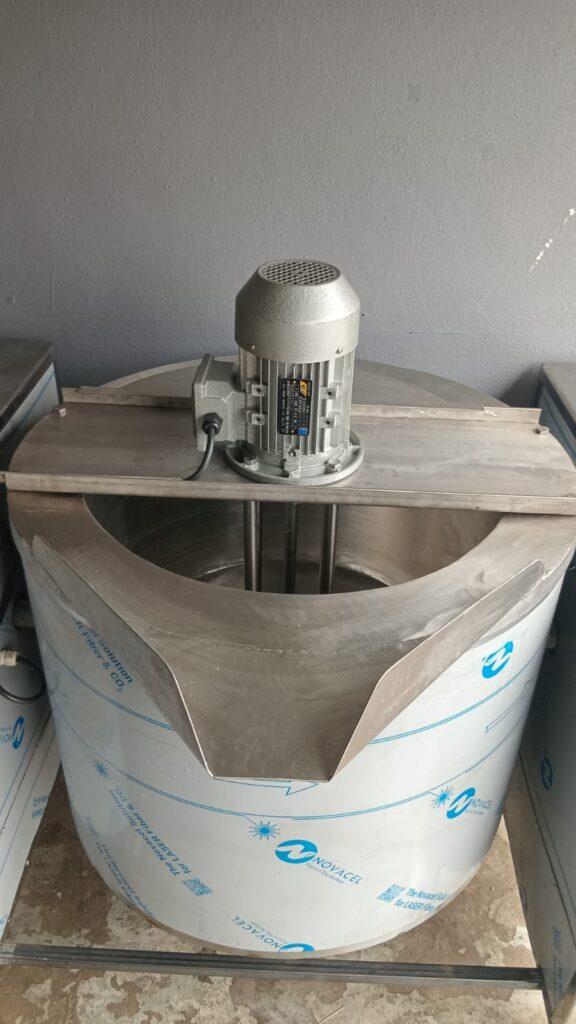
A Tilting Jacketed Mixing Tank is a versatile industrial vessel designed for heating, mixing, blending, and controlled discharge of liquid or semi-solid materials. It is widely used in food processing, chemical manufacturing, cosmetics production, pharmaceuticals, and detergents.
If you are searching for:
- Tilting jacketed mixing tank price
- Steam jacketed mixing tank manufacturer
- Stainless steel tilting mixing tank
- Jacketed tank with agitator
- Industrial cooking kettle with mixer
This guide covers everything you need to know — features, applications, sizes, motor power, batch capacity, and pricing.
What is a Tilting Jacketed Mixing Tank?
A tilting jacketed mixing tank is a stainless steel vessel equipped with:
- A heating jacket (steam, electric, or hot oil)
- An agitator or mixer
- A tilting mechanism for easy discharge
- A gearbox-driven motor system
The jacket surrounds the inner tank and allows uniform heating, while the mixing system ensures consistent blending without burning or uneven heating.
Key Features of a Tilting Jacketed Mixing Tank
1. Double-Layer Jacket Construction
- Inner tank for product
- Outer jacket for heating medium (steam/hot oil/electric heating)
2. Tilting Mechanism
- Manual tilting (hand wheel system)
- Motorized tilting system
- Hydraulic tilting option (for large tanks)
This feature eliminates the need for bottom discharge valves and reduces product wastage.
3. High-Quality Stainless Steel
- SS304 (food grade standard)
- SS316 (corrosion-resistant for chemicals & pharma)
4. Agitator Types
- Anchor mixer
- Scraper type mixer
- Paddle agitator
- High-speed homogenizer (optional)
5. Temperature Control
- Digital temperature controller
- Thermocouple sensor
- Steam pressure gauge (for steam models)
Applications & Uses
A tilting jacketed mixing tank is ideal for:
Food Industry
- Sauces and ketchup
- Syrups
- Jams and spreads
- Soups and gravies
- Dairy products
Chemical Industry
- Adhesives
- Liquid detergents
- Resin mixing
- Paint and coating preparation
Cosmetic Industry
- Creams and lotions
- Shampoo mixing
- Gel products
Pharmaceutical Industry
- Syrup manufacturing
- Liquid medicine preparation
Models, Sizes & Batch Capacity
Tilting jacketed mixing tanks are available in various sizes depending on production requirements.
| Tank Capacity | Working Volume | Motor Power | Heating Type |
|---|---|---|---|
| 50 Liters | 40–45 L | 0.5 HP | Electric / Steam |
| 100 Liters | 80–90 L | 1 HP | Electric / Steam |
| 200 Liters | 160–180 L | 1.5 HP | Steam |
| 300 Liters | 250–280 L | 2 HP | Steam |
| 500 Liters | 400–450 L | 3 HP | Steam / Hot Oil |
| 1000 Liters | 800–900 L | 5 HP | Steam / Thermal Oil |
Custom sizes are available for industrial production lines.
Motor & Agitation System
Motor size depends on:
- Product viscosity
- Batch size
- Required mixing speed
Typical Motor Specifications:
- 0.5 HP – Small lab or pilot units
- 1–2 HP – Medium production
- 3–5 HP – Large industrial batches
- Variable speed drive (VFD) optional
For thick products like sauces or creams, scraper-type agitators are recommended to prevent sticking and burning.
Heating Options
1. Steam Jacketed Mixing Tank
- Ideal for large-scale food processing
- Fast and uniform heating
- Energy efficient
2. Electric Jacketed Tank
- Suitable for small to medium production
- Easy installation
- Lower initial setup cost
3. Hot Oil / Thermal Oil Heating
- Used for higher temperature applications
Tilting Jacketed Mixing Tank Price
The price depends on:
- Capacity
- Material grade (SS304 or SS316)
- Motor power
- Heating system
- Automation level
Estimated Price Range:
- 50–100 Liters: R45 000+
- 200–500 Liters: R45 000+
- 1000 Liters & Above: R159 000+
For an accurate quotation, manufacturers typically require:
- Product type
- Batch size
- Heating method
- Required automation level
Advantages of Tilting Jacketed Mixing Tank
- Uniform heating and mixing
- Easy discharge system
- Reduced product wastage
- Hygienic stainless steel design
- Suitable for viscous materials
- Customizable design
How to Choose the Right Model
When selecting a tilting jacketed mixing tank, consider:
- Required batch size
- Product viscosity
- Heating source availability (steam or electric)
- Required temperature range
- Automation level
- Budget
For startups, electric 100–200L models are cost-effective.
For large factories, steam jacketed 500–1000L systems are recommended.
Why Invest in a Tilting Jacketed Mixing Tank?
If your production involves heating and mixing thick or temperature-sensitive materials, this machine provides:
- Better product consistency
- Higher production efficiency
- Improved hygiene standards
- Lower long-term operational cost
It is a critical machine for industrial food, chemical, and cosmetic production lines.