
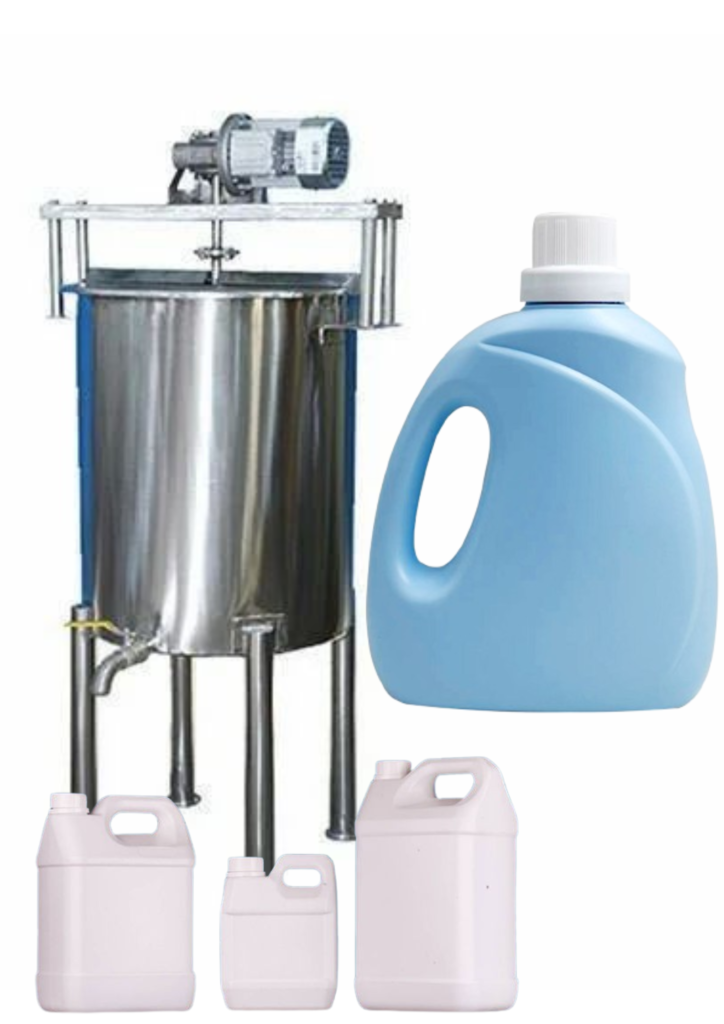
Introduction to Liquid Detergent Machinery
Liquid detergents — from dish soaps and laundry liquids to surface cleaners and industrial degreasers — are among the most widely manufactured products in household and industrial cleaning sectors. Producing them reliably and at scale requires a set of specialised machines collectively known as liquid detergent manufacturing machinery.
Whether you are a startup looking to mechanise your production for the first time, or a growing brand transitioning from semi-manual to fully automated operations, this guide will help you understand the machinery involved, how they work, key features to consider, and how to choose the right equipment for your business.
Why Machinery Matters in Liquid Detergent Production
Manual production limits output, consistency, hygiene, and scalability. Mechanised equipment brings tangible benefits:
- Consistent product quality and density
- Accurate dosing at every stage
- Higher production throughput
- Improved hygiene and fewer contamination risks
- Reduced manual labour and operational costs
- Professional packaging and brand presentation
Without the right machinery, scaling production or meeting regulatory and quality standards becomes difficult.
Core Liquid Detergent Manufacturing Machinery
A complete liquid detergent production line typically includes the following machines:
1) Mixing Tanks & Agitators
The centrepiece of any liquid detergent line.
Function:
Mix raw materials — water, surfactants, builders, thickeners, stabilisers, fragrance, colourants, and additives — into a homogeneous liquid.
Types:
- Jacketed mixing tanks for controlled heating/cooling
- Vacuum mixers to remove air bubbles
- High-shear mixers for thick or viscous formulas
Features to check:
Stainless steel construction, variable speed control, temperature control, and sealed lids.
2) Emulsifiers / Homogenizers
Used when your product contains oil-based additives or needs ultra-fine dispersion.
Function:
Break down particles and combine immiscible liquids to create stable formulas with smooth texture and uniform consistency.
When used:
Dish liquids with added oils, anti-bacterial agents, or transparent product lines requiring clarity.
3) Holding & Storage Tanks
Temporary storage between mixing and filling stages.
Function:
Keep batches at controlled conditions and feed the filling line smoothly.
Features:
Level indicators, sanitary valves, and optional heating/jacketed jackets.
4) Liquid Filling Machines
These are critical for bottling the liquid detergent into containers.
Types:
- Semi-automatic fillers
- Automatic rotary or inline fillers
- Pump or piston fill systems
Features:
Adjustable fill volumes, multiple heads for faster output, and food-grade materials for contact parts.
Best choice depends on your production scale and container size — from small bottles to large jerrycans.
5) Capping & Sealing Machines
Once bottles are filled, they need secure closure.
Types:
- Manual cappers for small batches
- Semi-automatic cappers
- Fully automatic capping heads for high throughput
Features to look for:
Adjustable torque control, compatibility with cap types (flip top, screw cap, pump cap) and integration with the filling line.
6) Labeling Machines
Labeling ensures your brand identity and regulatory compliance. Machines vary from simple semi-automatic labelers to fully automatic systems that can label round, flat, or irregular bottles.
7) Conveyors & Line Automation
For mid-to-large operations, conveyors improve flow between mixing, filling, capping, and labeling stages, reducing handling time and errors.
Optional Secondary Machinery
- Batch Documentation Systems for quality control
- Inline Mixers for continuous batching
- pH & Viscosity Sensors to monitor product traits
- Packing Machines for sachets or multipacks
Key Factors When Choosing Machinery
Production Capacity
Define your daily or monthly output goals (e.g., litres per day). Choose machines that match or exceed your target without over-capitalising.
Product Viscosity
Thin liquids need simple fillers; thicker formulas may require pump or piston fillers and stronger mixers.
Container Range
Ensure fillers and cappers handle the sizes you use — from small bottles to large jerrycans.
Material Quality
Cosmetics and detergents require food-grade stainless steel (SS304 or better) to resist corrosion and ensure hygiene.
Automation Level
Semi-automatic lines cost less and suit moderate output; fully automatic networks are best for high-volume, minimal labour setups.
Serviceability & Spare Parts
Machinery should be easy to maintain, with accessible spare parts and training for operators.
Typical Cost Considerations
Prices vary widely depending on capacity, automation, build quality, and features. As a general range:
| Machinery Component | Typical Price Range* |
|---|---|
| Small mixing tank with agitator | Lower range |
| Mid-size vacuum or high-shear mixer | Mid range |
| Semi-automatic filling machine | Lower to mid range |
| Fully automatic filler (multi-head) | Mid to higher range |
| Capping & labeling line | Mid range |
* Exact prices depend on supplier, customisations, and whether equipment is new or refurbished.
Steps to Set Up a Liquid Detergent Line
- Define your product formulation and batch size
Know your recipe, ingredient list, and production goals. - Select the right mixing system
Choose between batch mixers, vacuum mixers, or high-shear systems based on viscosity and formula complexity. - Choose a filling system that fits your volumes
Semi-automatic for startups or automatic for mid-to-large production. - Add capping and labeling systems
Ensure your finished product is market-ready. - Plan for quality control and compliance
Set up pH and viscosity checks, hygiene protocols, and documentation systems. - Train your operators
Skilled operators reduce downtime, prevent contamination, and improve product quality.
Benefits of Investing in Manufacturing Machinery
- Increased production speed and consistency
- Improved product quality control
- Reduced production costs per batch
- Enhanced brand professionalism
- Better hygiene and regulatory compliance
Final Thoughts
Whether you are launching your first detergent brand or scaling an existing operation, understanding liquid detergent manufacturing machinery is crucial. From mixing and emulsifying to filling, capping, and labeling, each machine plays a strategic role in quality, speed, and reliability.
Choosing the right equipment — and planning for future expansion — enables you to deliver consistent, market-ready detergents that meet consumer expectations and compliance standards.