
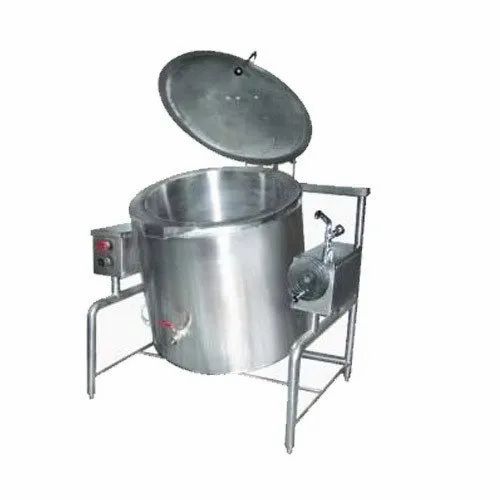
What Is a Steam Tilt Jacketed Pot?
A steam tilt jacketed pot (or tilting jacketed kettle) is a double-walled cooking vessel where steam circulates in the outer jacket to evenly heat the inner chamber. It includes a tilting mechanism (manual, hydraulic or electric) that allows you to safely and easily pour out the cooked contents.
This design is ideal for large-batch cooking of soups, sauces, creams, jams, or other viscous mixtures, especially when you want consistent heat and safe emptying.
Why South African Businesses Invest in Steam Tilting Kettles
- Safety and ergonomics: Tilting reduces the risk of burns by avoiding manual scooping or lifting of heavy pots.
- Efficient large-batch cooking: Steam heating provides even, controlled heat — good for high-volume production.
- Energy savings: Jacketed steam heating is more efficient than open-flame or direct-heat stovetops.
- Scalability: Useful whether you’re a catering business, central kitchen, or food / cosmetic manufacturer.
- Compliance: Local suppliers often build to South African safety and pressure-vessel standards.
Typical Sizes and Variants in South Africa
Steam tilt jacketed pots come in a variety of configurations, depending on your production needs:
- Small (50–100 L): Suitable for catering, small-batch sauces or skincare production.
- Medium (200–300 L): Useful for commercial kitchens, central production, or food factories.
- Large (above 300 L): Industrial-scale operations that cook hundreds of litres per batch.
- Single vs. Double Pot: Some models feature two tilted kettles side by side — useful for cooking multiple products.
- Tilting Mechanism Types:
- Manual lever
- Aqua-hydraulic (hydraulic system with water)
- Electric / motorised tilt
Price Range in South Africa (2025)
Prices vary depending on capacity, material (stainless steel), tilt mechanism, and whether the unit is steam-only or self-generating. As a guide:
- Small (50-100 L): ~ R 60,000 – R 150,000
- Medium (200-300 L): ~ R 120,000 – R 350,000
- Large / Industrial (> 300 L): R 300,000+ (for high-capacity or automated tilt)
These are indicative ranges — exact prices depend on the supplier, size, and configuration.
Important Features to Evaluate Before Buying
When assessing a steam tilt jacketed pot, check for:
- Material quality: Food-safe stainless steel (304 common, 316 for more corrosive products).
- Safety certification: Pressure-vessel rating, safety valves, pressure gauge, and compliance with local standards.
- Tilting mechanism:
- Manual lever: cheaper, but needs physical force.
- Aqua-hydraulic: smooth, easier for large volumes.
- Electric tilt: fastest and most convenient, but more expensive.
- Steam source: Some require an external boiler; others self-generate steam.
- Lid type: Hinged, spring-loaded, or removable — depending on cleaning and safety needs.
- Drain or discharge valve: Helps in controlled emptying of thick sauces or stews.
- Agitator/mixer (optional): Useful for high-viscosity or sticky mixtures that need constant stirring.
- Controls and automation: Temperature control, tilt control, and possible automation for production lines.
- Maintenance: Ease of access for cleaning, servicing the tilt mechanism, and testing valves.
Use Cases & Industries
Steam tilt jacketed pots are especially useful in:
- Central kitchens (schools, hospitals, catering)
- Food manufacturing (sauces, soups, jam, atchar)
- Cosmetic production (creams, lotions)
- Chemical or detergent production
- Large-scale catering businesses
If you need to cook and then safely pour large, hot batches, a tilting kettle is ideal.
Maintenance & Longevity Tips
To make your kettle last:
- Regularly test and calibrate safety valves.
- Service the tilt mechanism (especially hydraulic or electric) according to manufacturer guidelines.
- Clean the pot’s interior and jacket after each batch.
- Keep a maintenance logbook (pressure tests, inspections).
- Train staff on safe tilting and loading/unloading procedures.
Proper upkeep means longer life and greater safety.
Here are a few highlights:
- 250 L Moduluks Steam Tilt Pot: Mid-sized tilt kettle, steam-heated, good for commercial kitchens.
- 350 L Moduluks Steam Tilt Pot: Larger capacity, efficient for high-volume food production.
- 200 L Cassini Tilting Kettle: Reliable local-style kettle known in SA markets.
- 60 L Moduluks Steam Tilt Pot: Compact option for smaller food or cosmetic makers.
- 2.2 kW Stainless Tilt Stir Pot: Electric heating, tilt + stirring, ideal for cream or sauce production.
Pros & Trade-Offs
Advantages:
- Safe and efficient transfer of hot products
- Uniform heating via steam jacket
- Scalable for different batch sizes
- Suitable for both food and non-food production
Challenges:
- Higher capital cost than non-tilting pots
- Needs steam boiler or self-generation system
- Maintenance of tilt mechanism and pressure parts
- Safety checks for pressure-based equipment
Final Thoughts & Recommendations
If you’re looking for a steam tilt jacketed pot for sale in South Africa, this is a strong investment for any serious food or manufacturing business. The ability to cook large batches evenly and pour safely makes it a valuable asset.
Next steps you should take:
- Define your batch size and production frequency.
- Choose your tilt mechanism (manual, hydraulic, electric).
- Confirm whether you have or need a steam source.
- Request quotes from local (or import) suppliers.
- Ask for demonstrations or camera tests where possible.
- Factor in servicing and safety checks in your budget.