
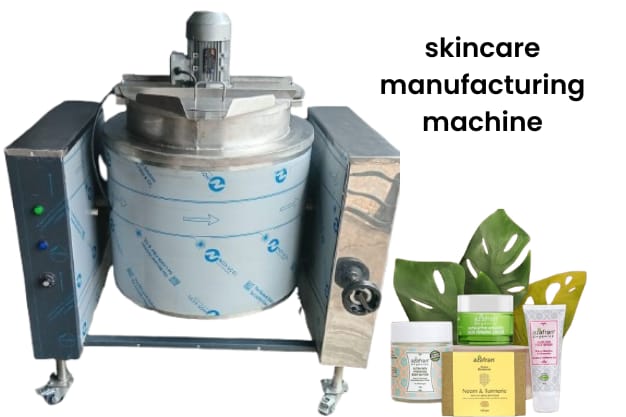
South Africa’s skin care, haircare and cosmetics manufacturing sector has grown fast over the last few years, with everyone from home-based beauty brands to established factories looking to scale production. The good news: skin care, haircare and cosmetics machine needs overlap far more than most first-time manufacturers expect — the same core equipment mixes a face cream, a conditioner, or a lotion, just tuned differently for viscosity and batch size.
This guide walks through the equipment that covers all three categories, where they differ, and how to work out what you actually need to buy first.
What Equipment Do Skin Care, Haircare & Cosmetics Machines Share?
Almost every product in this space — a face cream, a shampoo, a body lotion, a lip balm — goes through the same three production stages: mixing/emulsifying, optional heating or cooling, and filling into its final container. What changes between product types is the specific machine setup, not the underlying process.
Skin Care Manufacturing Equipment
Creams, lotions, serums and body butters need a high-shear mixer or homogenizer to properly emulsify oil and water phases into a stable, smooth product that won’t separate on the shelf. Thicker creams and butters often need a jacketed tank as well, since many emulsions only form properly at a controlled temperature before cooling down to their final texture.
The exact setup depends on the product: a lightweight serum or toner is often thin enough to mix at room temperature with a simple homogenizer, while a rich night cream or body butter usually needs the oil phase melted and held at temperature in a jacketed tank before it’s emulsified into the water phase. Sunscreens add another layer of difficulty, since UV filters need thorough, even dispersion to perform correctly on skin — under-mixing here directly affects SPF performance, not just texture.
Typical containers — jars, airless pump bottles, dropper bottles for serums — also influence which filling machine pairs best with your mixer, since a thick cream and a thin serum need very different filling mechanisms.
Haircare Manufacturing Equipment
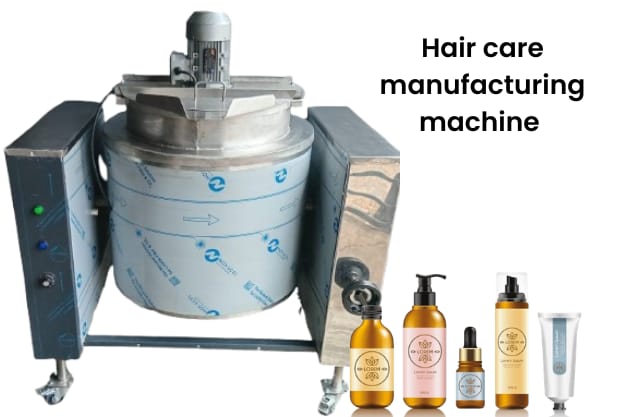
Shampoo, conditioner and hair oil production uses the same mixing principles as skin care, but viscosity and foaming behaviour change the setup. Shampoo bases need gentle, controlled mixing to avoid over-aerating the product and trapping air bubbles, while conditioners — often thicker, with waxes or silicones — may need light heating to blend cleanly.
Hair oils and serums are usually the simplest product in the category to produce, since blending carrier and essential oils rarely needs heat or high shear — a straightforward mixer is often enough. Hair masks and deep conditioning treatments sit closer to a skin care cream in thickness and generally need the same jacketed-tank-plus-homogenizer setup. If you’re formulating sulfate-free shampoo bases, mixing speed matters even more, since these gentler surfactant systems are more sensitive to over-aeration than traditional sulfate formulas.
Cosmetics Machine Essentials
Colour cosmetics, lip products and powder-based cosmetics add pigment dispersion to the mix — grinding and evenly distributing pigment particles through a base so colour is consistent from batch to batch. This is where a dedicated high-shear or bead-mill style mixer earns its cost over a basic paddle mixer.
Liquid foundation and BB cream follow the same emulsion process as a skin care cream, with pigment dispersion added as an extra step. Lip balm and lipstick are different again — they’re wax-and-oil based rather than water-based, so they need a jacketed tank to melt and hold the blend at temperature before it’s poured or filled, with no water phase to emulsify at all. Pressed or loose powder cosmetics (powder foundation, blush, eyeshadow) go back to dry mixing, closer to a ribbon blender than a homogenizer, since there’s no liquid phase to emulsify.
Choosing the Right Machine for Your Product
- Thin liquids and toners: a simple mixer or homogenizer, no jacket needed.
- Creams, lotions and conditioners: a high-shear homogenizer, jacketed if the formulation needs heat.
- Pigmented cosmetics: a high-shear mixer capable of fine, even dispersion.
- Any of the above at retail scale: a filling machine matched to your container — jars, bottles, tubes or sachets.
Typical Batch Sizes & Production Planning
Most first-time brands under-plan on capacity in one direction or the other — either buying a machine too small to grow into, or over-buying capacity that sits half-empty for the first year. A useful rule of thumb: size your mixer for your busiest month’s expected volume about a year out, not your current volume, since retooling a production line twice in two years costs more than buying slightly ahead.
Small-batch brands typically start in the tens-of-litres range per batch, scaling into the hundreds of litres as wholesale and retail orders grow. Contract manufacturers and established factories often run multiple batch sizes across different tanks to serve both small custom orders and larger repeat runs.
Common Mistakes First-Time Manufacturers Make
- Skipping the jacket to save money on a product that actually needs controlled heating — leading to inconsistent batches or formulations that never fully emulsify.
- Undersizing the motor for thicker products like butters and lip balm bases, causing strain and premature wear.
- Not planning for cleaning downtime between product changeovers, which quietly eats into daily production capacity.
- Buying one machine to do everything across very different product types (thin serums and thick pigmented creams, for example), when two simpler machines would run faster and clean more easily.
Who Uses This Equipment
First-Time Beauty Brands
Entrepreneurs launching a skin care or haircare line typically start with one flexible mixer sized for small batches, adding a jacketed tank or dedicated filler as volume grows.
Established Manufacturers
Factories running multiple product lines — creams, shampoos and cosmetics side by side — often run dedicated mixers per product family to avoid cross-contamination and reduce cleaning downtime between batches.
Contract Manufacturers
Producers making products for multiple brands need equipment flexible enough to handle varying viscosities and batch sizes without a full retool between jobs.
Features to Look For
Cosmetic-Grade Stainless Steel
304 or 316 stainless steel resists corrosion from active ingredients and meets hygiene expectations for skin-contact products.
Variable Speed Control
Different formulations need different shear intensity — a fixed-speed mixer limits which products you can actually run on it.
Easy-Clean Design
Smooth welds and accessible mixing heads cut changeover time when switching between product lines or colours.
New vs Used Equipment
Used mixers and homogenizers do come up for sale, but on skin-contact equipment, unverifiable cleaning history and unknown seal wear are real risks — residue from a previous formulation is hard to confirm is fully gone. A new machine built to your specification comes with a known material grade and a warranty.
Frequently Asked Questions
Q: Can one machine make skin care, haircare and cosmetics products?
Often yes for the mixing stage, provided it’s cleaned properly between product types — but many manufacturers running multiple lines prefer dedicated machines per category to avoid cross-contamination and reduce downtime.
Q: Do I need a jacketed tank for skin care and haircare products?
Only if your formulation requires heating to blend properly, such as creams with waxes or butters that need melting. Thin liquids, toners and many shampoos don’t need a jacket.
Q: What size machine should a first-time brand start with?
Most first-time brands start with a smaller-capacity mixer sized to their current batch volume, since it’s cheaper to run two batches on a smaller machine than to buy oversized capacity you won’t use for years.
Q: How do I avoid cross-contamination between different products?
Thorough cleaning between batches, dedicated mixers for very different product types (such as pigmented cosmetics vs. clear serums), and a documented cleaning process are the standard approach.
Q: Can the same machine make lip balm and face cream?
Not well — lip balm is a wax-and-oil blend with no water phase, while face cream is an emulsion of oil and water. They need the same jacketed heating principle but a different mixing approach, so most manufacturers running both use separate equipment.
Q: How much does a basic skin care or haircare production setup cost?
It depends heavily on capacity and whether a jacketed tank is required, so we price against your actual product and batch size rather than a fixed number. Tell us what you’re formulating and we’ll put together a setup and quote.
Conclusion
Skin care, haircare and cosmetics machine needs share the same foundation — mixing, optional temperature control, and filling — with the details tuned to your specific formulation and batch size. Getting the mixing stage right is usually the difference between a stable, shelf-ready product and one that separates or underperforms.
Ready to spec equipment for your product line?
SME Machinery builds mixers, homogenizers, jacketed tanks and filling machines in Germiston for skin care, haircare and cosmetics manufacturers. Tell us your product and volume and we’ll help you match the right setup.
Skin Care Machines · Haircare Machines · Cosmetics Machine (Homogenizers)