
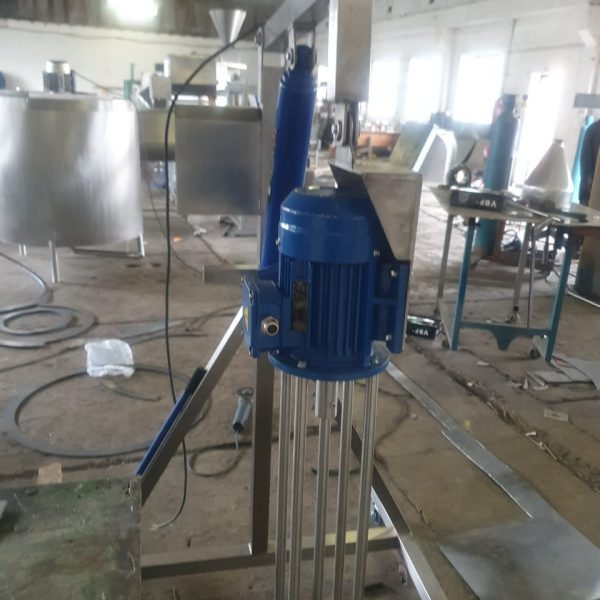
“Industrial mixer” covers a lot of ground — a machine that gently folds spices into mince and a machine that emulsifies cream at high shear are both technically industrial mixers, but they do completely different jobs. Choosing the wrong type wastes money and, worse, can leave you unable to hit the product consistency your customers expect.
This guide breaks down the main types of industrial mixers used across South African food, cosmetic and chemical manufacturing, and how to work out which one actually fits your product.

What Is an Industrial Mixer?
An industrial mixer is any commercial-scale machine used to combine, blend, emulsify or homogenise raw materials into a consistent finished product. That’s a broad definition on purpose — the category spans everything from low-speed ribbon blenders for dry powders to high-shear mixers that break down particles at a microscopic level.
What actually matters for your business isn’t the category, it’s the mixing action: does your product need gentle folding, vigorous agitation, or high-shear emulsification? That single question narrows the choice fast.
Main Types of Industrial Mixers
Ribbon and Paddle Mixers
Ribbon and paddle mixers use rotating blades to fold dry powders, granules, spices and semi-wet mixtures together. They’re the standard choice for spice blends, detergent powders, animal feed, and products like mango atchar where you want even distribution without breaking down the pieces.
High-Shear / Homogenizer Mixers
High-shear mixers (Silverson-type and inline homogenizer pumps fall into this group) use a rotor-stator head spinning at high speed to emulsify liquids, break down particles to a uniform micron-level size, and stabilise mixtures that would otherwise separate — creams, sauces, lotions and dairy products are typical uses.
Jacketed Mixing Tanks
A jacketed tank adds temperature control to the mixing process. An outer jacket circulates hot or cold oil, water or steam around the vessel, so the product can be heated, cooked or cooled while an agitator keeps it moving — useful for sauces, jams, lotions and anything that needs a controlled temperature profile during mixing.
Vertical and Tumble Mixers
Vertical mixers use a rotating screw or ribbon inside a cone-shaped or upright vessel, giving fast, uniform mixing in a smaller factory footprint than a horizontal unit — a common choice when floor space is tight but batch sizes still need to scale.
How to Choose the Right Mixer for Your Product
By Product Consistency
Dry powders and granules generally call for ribbon or paddle mixing. Liquids, emulsions and anything needing a smooth, stable texture call for high-shear mixing instead.
By Batch Size and Throughput
Small and growing operations usually start with a single machine sized for their current volume, with room to add a second unit or a larger tank as demand grows, rather than over-buying capacity up front.
By Temperature Requirements
If your process involves heating, cooking or precise cooling — jams, sauces, lotions, dairy — a jacketed tank is usually non-negotiable, since standalone mixers have no way to control product temperature during mixing.
By Industry
Food and spice producers lean toward ribbon blenders and jacketed pots. Cosmetic and pharmaceutical manufacturers lean toward high-shear homogenizers. Detergent and chemical manufacturers often use a combination of both, depending on the product line.
Industries That Rely on Industrial Mixers
Food & Beverage Production
Sauces, dressings, spice blends, dairy and juice producers all depend on consistent mixing to keep product quality uniform across every batch.
Cosmetics & Personal Care
Creams, lotions, serums and shampoos need high-shear mixing to emulsify oil and water phases into a stable, smooth product.
Detergent & Chemical Manufacturing
Powder and liquid detergents, industrial cleaning chemicals and agrochemicals rely on mixers sized for their specific viscosity and volume.
Features to Look For
Food-Grade Stainless Steel
304 or 316 stainless steel resists corrosion and meets hygiene requirements across food, cosmetic and pharmaceutical applications.
Motor Power and Build Quality
A mixer sized correctly for your viscosity and batch volume avoids strain on the motor and reduces downtime over the machine’s life.
Ease of Cleaning
Smooth welds, accessible mixing chambers and CIP-compatible design cut cleaning time between batches and product changeovers.
Factors That Affect Price
Several factors influence what an industrial mixer costs:
- Mixing action (ribbon/paddle vs high-shear)
- Tank or bowl capacity
- Stainless steel grade
- Whether a heating/cooling jacket is required
- Motor power and control options
- Manual vs automated operation
Buying a machine sized correctly for your actual product and volume, rather than the cheapest generic option, is usually what determines whether it’s still running reliably in five years.
New vs Used Industrial Mixers
Used industrial mixers do come up for sale, and checking the market is a reasonable step. But on food-contact and cosmetic-contact equipment, unknown wear on seals and bearings, no warranty, and an unverifiable cleaning history are real risks. A new machine built to your specification gives you a known material grade, a warranty, and local support if something needs attention.
Frequently Asked Questions
Q: What’s the difference between a ribbon mixer and a paddle mixer?
Both fold ingredients together with rotating blades, but a ribbon mixer uses a double-helix ribbon that moves material in two directions at once for fast, thorough blending of dry powders, while a paddle mixer mixes more gently — better suited to semi-wet or delicate products where you don’t want particles broken down.
Q: Can one mixer handle both dry powders and liquids?
Ribbon and paddle mixers can handle semi-wet mixtures, such as adding a small amount of oil or liquid to a dry blend, but they’re not built for high-liquid-content emulsions. If your product is mostly liquid, or needs oil and water phases properly emulsified, a high-shear mixer is the right tool instead.
Q: How often should an industrial mixer be serviced?
Bearings, seals and drive components should be checked on a routine schedule, commonly every few months under regular use, with a full inspection at least annually. Machines running multiple shifts a day need more frequent checks than one used for a single batch a week.
Q: Do I need a jacketed tank if I’m not heating my product?
No — if your process doesn’t involve heating, cooking or precise cooling, a standard mixer or tank is cheaper to buy and simpler to maintain. Jacketed tanks earn their extra cost specifically when temperature control is part of the process.
Conclusion
There’s no single “best” industrial mixer — the right choice depends entirely on your product, batch size, and whether temperature control matters to your process. Matching the mixing action to what you’re actually making is what determines whether a machine earns its keep.
Not sure which mixer fits your product?
SME Machinery builds all three main types in Germiston — ribbon & paddle, Silverson-type high-shear, and oil/water jacketed tanks. Tell us your product and volume and we’ll match the right one.
Ribbon & Paddle Mixers · Silverson Homogenizer Mixers · Jacketed Mixing Tanks