

Introduction A heat jacketed tank is an essential piece of processing equipment used in industries that require controlled heating during mixing, dissolving, melting, or reaction processes. By allowing precise temperature regulation, heat jacketed tanks help manufacturers maintain product consistency, improve processing efficiency, and ensure quality across every batch. These tanks are widely used in food processing, cosmetics, pharmaceuticals, chemicals, detergents, oils, and specialty manufacturing where heat plays a critical role in formulation. What Is a Heat Jacketed Tank? A heat jacketed tank is a vessel designed with an outer jacket that circulates a heating medium around the inner product chamber. The jacket transfers heat evenly to the contents inside the tank without direct contact between the heating source and the product. Heating can be achieved using hot water, thermal oil, steam, or electric heating elements, depending on application requirements. How a Heat Jacketed Tank Works The product is loaded into the inner tank while the heating medium flows through the surrounding jacket. Heat is transferred uniformly through the tank walls, ensuring: Temperature sensors and controllers allow operators to maintain precise heat levels throughout the process. Key Features of Heat Jacketed Tanks Common Heating Methods Hot Water Jacket Ideal for gentle heating and temperature-sensitive products. Oil Heated Jacket Suitable for higher temperature requirements and long heat retention. Steam Jacket Provides rapid heating for industrial and high-volume production. Electric Heating Jacket Used where steam or oil systems are not available. Applications of Heat Jacketed Tanks Food & Beverage Manufacturing Cosmetics & Personal Care Chemical & Detergent Production Pharmaceutical & Herbal Processing Industrial Oils & Specialty Products Tank Sizes & Capacity Options Heat jacketed tanks are available in a wide range of capacities, including: Common sizes range from 20 litres to over 5,000 litres, depending on production needs. Material & Construction Most heat jacketed tanks are manufactured using: This construction ensures durability, hygiene, and compliance with industry standards. Benefits of Using a Heat Jacketed Tank Heat Jacketed Tank vs Non-Jacketed Tank Feature Heat Jacketed Tank Standard Tank Temperature Control Yes No Heating Uniformity High Uneven Product Stability Excellent Variable Application Range Wide Limited For heat-dependent processes, jacketed tanks are significantly more efficient and reliable. How to Choose the Right Heat Jacketed Tank When selecting a heat jacketed tank, consider: Correct sizing and heating method selection are critical for long-term performance. Maintenance & Safety Considerations Proper maintenance extends equipment life and ensures safe operation. Conclusion A heat jacketed tank is a vital investment for manufacturers who rely on controlled heating during production. Its ability to deliver consistent temperature, improve efficiency, and protect product quality makes it indispensable across food, cosmetic, pharmaceutical, chemical, and industrial sectors. By choosing the right capacity, heating method, and construction, businesses can significantly enhance productivity and product reliability.
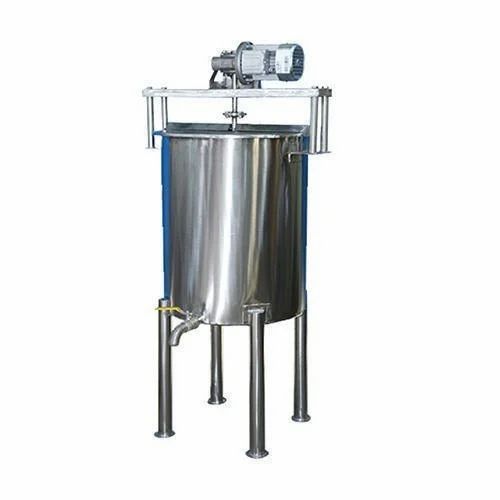
INDUSTRIAL MIXER 1000 L – COMPLETE BUYER & TECHNICAL GUIDE
Introduction: Why Choose an Industrial Mixer 1000 L? An industrial mixer 1000 L is a high-capacity mixing solution designed for production environments that require uniform blending of large batches of liquids, powders, pastes, gels, or semi-viscous materials. Its large volume capacity makes it ideal for commercial manufacturing facilities in food, cosmetics, pharmaceuticals, detergents, and chemical production. The 1000 L industrial mixer balances capacity, power, and space efficiency, serving manufacturers who need professional performance without the footprint of much larger mixing systems. What Is an Industrial Mixer 1000 L? An industrial mixer 1000 L is essentially a mixing machine with a 1000-litre working capacity. It uses robust motors, drive systems, and mixing elements (paddles, propellers, anchors, or high shear heads) to achieve homogeneous blending across large volumes. These mixers are engineered for continuous or batch production, allowing operators to process mid-to-high production volumes efficiently. Key Features of a 1000 L Industrial Mixer 1. Large Capacity Mixing Tank A 1000 L tank offers significant batch size for commercial production without the complexity of very large industrial systems. 2. Heavy-Duty Motor & Drive 3. Stainless Steel Construction Food-grade or chemical-grade stainless steel tanks ensure hygiene, corrosion resistance, and durability. 4. Interchangeable Mixing Agitators Depending on application: 5. Variable Speed Controls Allow precise control over mixing action and results. 6. Easy Cleaning & Maintenance Sanitary design helps reduce downtime and supports regulatory compliance. Industrial Applications Food & Beverage Manufacturing Chemical & Detergent Production Cosmetics & Personal Care Pharmaceutical Production Specialty Industrial Materials A 1000 L industrial mixer is versatile enough to handle a variety of viscous and non-viscous products — making it a staple for multi-product facilities. Motor Sizes & Drive Systems Industrial mixer 1000 L machines rely on robust motors and drives to handle large batches effectively. Typical Motor Power Options: A strong gearbox and stable drive system ensure reliable torque delivery without stalling under load. Batch Capacity, Throughput & Efficiency While rated at 1000 L, many mixers operate best at 60–80% working volume, ensuring optimal mixing dynamics. Effective batch size for most industrial mixers is around 600–800 L per cycle. Larger batch sizes boost throughput and reduce the number of cycles per shift — meaning less downtime and more productive hours. Benefits of an Industrial Mixer 1000 L 1. High Production Output Process larger batches with fewer cycles — ideal for commercial manufacturing. 2. Uniform Mixing Achieve consistent blend quality batch after batch. 3. Reduced Labour Automation or semi-automation cuts manual intervention. 4. Versatile Agitator Options Adaptable to powders, liquids, pastes, and emulsions. 5. Long-Term Reliability Industrial construction leads to extended service life. 6. Regulatory Compliance Sanitary stainless steel build supports hygiene standards. How to Choose the Right 1000 L Industrial Mixer 1. Product Type & Viscosity Thick pastes need stronger motors and anchor agitators; liquids need propellers. 2. Speed & Torque Requirements Select motor power and gearbox suited to your formulation. 3. Cleaning & Sanitation Needs Food and cosmetics require polished stainless steel and sanitary design. 4. Automation Requirements Manual vs semi-automatic controls affect speed and operator involvement. 5. Integration with Production Line Consider how the mixer fits with filling, packaging, and material handling systems. Common Questions About Industrial Mixers Q: Can a 1000 L mixer handle thick pastes?A: Yes. With the right agitator, motor size, and speed control, viscous products are handled effectively. Q: Is stainless steel necessary?A: For food, chemical, pharmaceutical, and cosmetic products, stainless steel contact parts are recommended to meet hygiene standards. Q: How long does a typical batch take?A: Batch times vary with product type and viscosity — typically 10–30 minutes per batch for homogeneous mixing. Conclusion An industrial mixer 1000 L provides a perfect balance of production capacity, reliability, and flexibility for manufacturers aiming to scale their operations. Whether you process food, chemicals, detergents, pharmaceuticals, or personal care products, a well-chosen 1000 L mixer boosts productivity, ensures consistent quality, and supports long-term manufacturing goals. With thoughtful specification — including appropriate agitators, motor power, and sanitary design — this mixer becomes a cornerstone of any modern production line.