
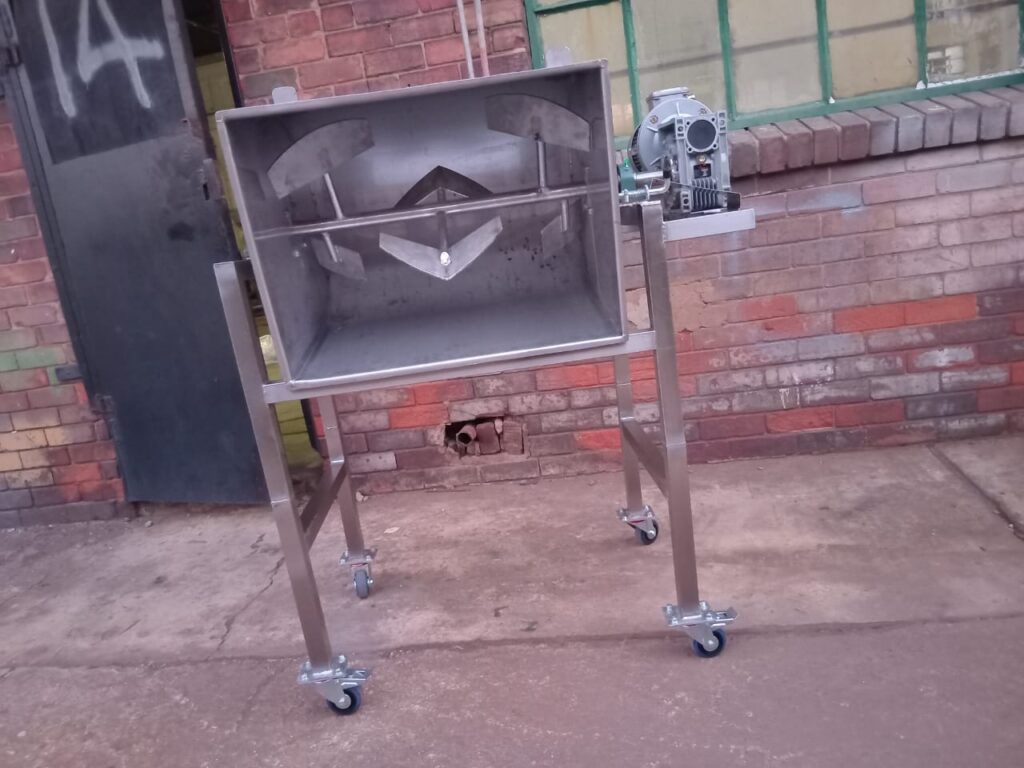
A ribbon paddle mixer is a type of industrial blending machine designed to mix powders, granules, and other dry or semi-dry materials with high efficiency and uniformity. It uses a combination of “ribbon” and “paddle” style mixing elements: the ribbon gives gentle bulk flow, while the paddles ensure intense, localized mixing. This dual-action design makes it ideal for handling mixtures that need consistent blending without damaging fragile particles.
Why Use a Ribbon Paddle Mixer in Your Business?
- Excellent Homogeneity
The combination of ribbon and paddle blades ensures even mixing throughout the batch, reducing the risk of unmixed pockets. - Gentle on Materials
The ribbon part moves gently, reducing shear, which is valuable when working with delicate powders, fragile granules, or heat-sensitive ingredients. - Versatility
Suitable for a wide range of materials: spices, food powders, pharmaceutical ingredients, chemical granules, feed, and cement additives. - Scalable Capacity
Mixers come in many sizes: from small laboratory-scale units to large 1 000 L or more industrial versions. - High Throughput
With the right design, paddle-ribbon mixers can achieve fast blending cycles, saving time in large-scale production. - Easy Discharge
Many mixers include a bottom discharge valve or door, which makes it simple to empty the mixed product cleanly and efficiently.
Key Features to Look for in a Ribbon Paddle Mixer
When evaluating a ribbon paddle mixer, consider:
- Construction Material: Stainless steel (304 or 316) is preferred for hygiene, corrosion resistance, and durability.
- Blade Design: The mixer should have a correctly engineered ribbon, plus paddles that optimize flow and mixing.
- Motor and Gearbox: Use a reliable motor and a gear reducer designed for continuous use; check for vibration and smooth operation.
- Mixing Speed: Adjustable speed is useful — slower speeds for fragile materials, higher speeds for dense powders.
- Discharge Mechanism: A good bottom valve or door ensures fast, full discharge and minimal residue.
- Loading and Cleaning: A well-designed mixer has easy-to-open lids, manways, or access ports for loading and cleaning.
- Instrumentation: Thermowells, sight glasses, level indicators, and sampling ports improve control and QA.
- Safety Features: Guards, emergency stop buttons, and over-torque protection help keep operators safe.
- Optional Features:
- Dust-tight covers for toxic or fine powders
- Vacuum or pressurisation capability for special processes
- Insulation or heating jackets if your powders are temperature-sensitive
Common Industries & Applications
A ribbon paddle mixer is especially useful in:
- Food Manufacturing: Spice blends, flour fortification, baking mixes
- Pharmaceuticals: Granules for tablets, herbal powder blends
- Chemicals: Dry chemical compounds, fertiliser formulations, detergent powders
- Animal Feed: Mineral premixes, feed additives
- Construction Materials: Additives, cement powders, specialty blends
Advantages & Trade-offs
Advantages:
- Uniform mixing with minimal segregation
- Gentle handling reduces product breakdown
- Flexible capacity and scalable design
- Lower energy usage compared to high-shear mixers
- Good for both fragile and dense materials
Trade-offs:
- Larger footprint compared to simpler mixers
- Requires careful design to achieve ideal ribbon/paddle geometry
- May need regular maintenance of seals and discharge valves
- Not always suitable for ultra-fine or extremely cohesive powders without additional modifications
How to Choose the Right Ribbon Paddle Mixer
- Estimate Your Batch Size:
Calculate how many kilograms or litres you mix per batch to choose the correct mixer capacity. - Know Your Material Characteristics:
Determine particle size, bulk density, abrasiveness, and fragility — these affect blade design and material choice. - Decide on Throughput:
How fast do you need to blend? For high-speed mixing, ensure the motor and gearbox are rated for heavy duty. - Cleaning Requirements:
If you switch products often, you will need a mixer that is easy to clean and sanitize. - Location & Installation:
Consider floor space, power supply (voltage, phase), and if you need lifting access for the mixer. - Budget & Support:
Confirm you have budget not only for purchase but for spares, maintenance, and service support.
Maintenance Tips for Long-Term Performance
- Inspect and lubricate the gearbox regularly.
- Check the ribbon and paddle blades for wear or bending.
- Monitor the discharge valve for seal wear.
- Clean the internal surfaces thoroughly after each batch, especially if switching products.
- Maintain a maintenance log to track service intervals and repairs.
- Train operators on correct operation, loading, speed changes, and safety protocols.
Final Thoughts
A ribbon paddle mixer is a powerful and flexible blending machine that brings together the best of both ribbon and paddle mixing technologies. It’s particularly suitable for businesses that need even mixing of powders and granules, but also want to preserve the integrity of fragile ingredients and maintain high throughput.
Investing in a quality ribbon paddle mixer can significantly improve product quality, reduce waste, and increase your production capacity. Before buying, clearly define your batch size, material properties, cleaning frequency, and budget — and choose a mixer that matches these needs.